Blog

  • Mortgage Renewal BC 2026: Step-by-Step Guide to Renewing Your Mortgage in British Columbia

    Mortgage Renewal BC 2026: Step-by-Step Guide to Renewing Your Mortgage in British Columbia


    Mortgage Renewal BC 2026: Step-by-Step Guide to Renewing Your Mortgage in British Columbia

    Ready to explore your renewal options?

    Book a free 20-minute renewal consultation with a BC mortgage broker

    Book Free Consultation →

    Mortgage Renewal BC 2026: Step-by-Step Guide to Renewing Your Mortgage in British Columbia

    By Varun Chaudhry  |  President, Kraft Mortgages Canada Inc.  |  April 8, 2026

    Updated April 2026. If your mortgage term is ending in BC, you have a renewal decision to make — and the choices you make right now can affect your monthly payments and long-term financial flexibility for years. Most homeowners in British Columbia simply sign whatever their current lender sends. That’s often the most expensive mistake in mortgage ownership.

    This guide walks you through the mortgage renewal BC process step by step — when to start, how to compare mortgage renewal rates BC, whether switching lenders makes sense, what penalties you might face, and how to avoid common renewal mistakes. No guarantees, no pressure — just a clear path forward.

    What Is Mortgage Renewal in BC?

    In British Columbia, a mortgage renewal is when your existing mortgage term comes to an end and you sign a new agreement — either with your current lender or a new one. Unlike refinancing, a renewal doesn’t typically involve pulling out equity; it’s simply replacing your expiring mortgage with a new one.

    Your lender will usually send you a renewal offer 4 to 6 months before your maturity date. That offer is often presented as a fait accompli — just sign here and you’re done. But that almost never serves you as well as it serves the lender.

    Key difference: In BC, mortgage renewals are governed by federal legislation (the Bank Act and Mortgage Broker Act) as well as BC-specific consumer protection rules. A licensed mortgage broker can help you understand what’s available across the full market — not just your current bank’s shelf.

    When to Start Your Mortgage Renewal in BC

    Timing matters more than most homeowners realize. Here’s a practical timeline to follow:

    • 120 days (4 months) before maturity — Start comparing rates and options. This is when lenders begin sending renewal offers. This is also when you should consult a mortgage broker.
    • 90 days before maturity — Make your decision. If switching lenders, you’ll need time for paperwork, title search, and onboarding.
    • 60 days before maturity — Your current lender may send a final “we can match or beat it” counter-offer. Use this to your advantage.
    • 30 days before maturity — Paperwork should be finalized. Don’t leave it to the last minute — if something delays your switch, you could roll into a costly holdover rate.

    Why Starting Early Matters

    Starting early gives you leverage. When you know what competitors are offering, your current lender often improves their offer. It also prevents you from accidentally rolling into a holdover rate — a significantly higher rate that applies if your mortgage renews without a signed agreement.

    📋 Broker Field Notes — Renewal Reality Checks

    In our files, we regularly see two patterns that cost homeowners money:

    • Renewal blindness. Clients receive their lender’s offer, assume it’s the best available, and sign without shopping around. In a rising or volatile rate environment, this can mean paying 0.25%–0.75% more than necessary — on a $400,000 mortgage, that’s $83–$250 per month.
    • Deadline panic. Clients who wait until 30 days before maturity and then discover switching lenders takes 4–6 weeks. They either pay switcher penalties or get locked into the holdover rate.

    Start your renewal research at the 120-day mark. That’s the single most valuable habit a BC homeowner can build.

    Step-by-Step: How to Renew Your Mortgage in BC

    Step 1 — Pull Your Current Mortgage Details

    Before comparing anything, know where you stand. Gather:

    • Current outstanding balance
    • Current interest rate and maturity date
    • Current lender name and contact
    • Any prepayment privileges (lump-sum payments, increased payments)
    • Whether your mortgage is collateral or standard charge

    Step 2 — Check Current Mortgage Renewal Rates BC

    BC homeowners have access to three lending tiers:

    • A-lenders — Major banks and credit unions. Typically the lowest rates. Strict eligibility requirements.
    • B-lenders — Mid-tier institutions like Home Trust, Equitable Bank, Community Trust. Slightly higher rates, more flexible criteria.
    • Equity lenders — Institutional private lenders (not individual investors). May be appropriate if your income, credit, or property situation doesn’t fit A or B lender boxes.

    Comparing across all three tiers gives you a complete picture. A mortgage broker can run these comparisons simultaneously.

    Step 3 — Decide: Stay or Switch

    Switching lenders at renewal is generally simpler than switching mid-term because you’re not breaking anything — you’re just starting fresh somewhere new. Consider switching if:

    • Your current lender’s renewal offer is above market
    • Your financial situation has changed and you want different product features
    • You want to consolidate debts or access equity (in which case a refinance, not just a renewal, may be appropriate)
    • You’ve improved your credit score and now qualify for better A-lender pricing

    Step 4 — Understand Penalty for Breaking Mortgage

    At renewal, you’re not breaking your mortgage — you’re replacing it. However, if you switch lenders, there may be a small discharge/admin fee (typically $250–$400). This is different from the penalty for breaking mortgage mid-term, which is usually 3 months’ interest or the interest rate differential (IRD).

    At renewal, your existing mortgage is simply expiring. You can walk away to any lender with no breakage penalty. This is one of the most important rights BC homeowners have — and one that lenders count on you not using.

    Step 5 — Review the Fine Print

    Before signing any renewal agreement, confirm:

    • Prepayment privilege size (how much extra you can pay annually without penalty)
    • Portability — can you take this mortgage to a new property?
    • Collateral vs. standard charge (collateral charges are harder to move away from)
    • Any rate hold or rate cap features being offered

    Step 6 — Sign and Set Up Payments

    Once you’ve chosen your lender and product, you’ll sign new documents. Your lawyer or notary will handle the registration. Set up your payment schedule at the same time. Many homeowners miss the opportunity to adjust their payment frequency (e.g., switching from monthly to bi-weekly) to reduce total interest paid over the life of the mortgage.

    Wondering whether to renew with your bank or switch?

    A 20-minute call with a BC mortgage broker can reveal whether you’re on the right rate. No commitment.

    Get a Free Renewal Review →

    Should You Switch Lenders at Renewal?

    This is one of the most common questions we get. The answer depends on a few factors:

    • Rate differential. If your current lender’s offer is more than 0.20% above what’s available elsewhere, switching almost always pays off — even after admin fees.
    • Relationship value. Some banks offer loyalty discounts for existing customers. These are worth considering, but don’t accept them at face value — always verify them against market rates.
    • Product fit. If your current mortgage has prepayment features you use (e.g., 20% lump-sum payments), make sure any new lender matches or exceeds them.
    • Collateral charge. If your current mortgage is registered as a collateral charge, switching lenders requires discharging and re-registering — talk to a mortgage broker about whether this complexity is worth it for your situation.

    How to Get the Best Mortgage Renewal Rates BC in 2026

    There’s no single “best rate” — the best rate is the one that fits your situation and is available to you. Here’s how to position yourself:

    • Check your credit score. A score above 680 typically unlocks A-lender pricing. Above 720 gets you the most competitive offers.
    • Reduce your GDS and TDS ratios. Lenders calculate how much of your gross income goes to housing costs (GDS) and total debt (TDS). Lower ratios = better rates.
    • Shop multiple lenders. Different lenders weight income, property type, and credit differently. What one lender declines, another may embrace.
    • Use a mortgage broker. Brokers have access to 30+ lenders and can present the full picture in one conversation — no multiple bank appointments needed.
    • Consider the term carefully. A 5-year fixed is the most common, but 3-year, 4-year, 7-year, and 10-year terms are all available. Think about your stability and rate expectations.

    📌 BC Homeowner Checklist: Mortgage Renewal Prep

    • ☐ Pull current mortgage statement — balance, rate, maturity date
    • ☐ Pull Equifax/TransUnion credit report (free at Borrowell.ca or Credit Karma)
    • ☐ List all current debts (credit cards, car loans, HELOC balances)
    • ☐ Calculate your approximate GDS/TDS ratios
    • ☐ Research current market rates (bank websites, rate aggregator sites)
    • ☐ Book a broker consultation — ideally 120 days before maturity
    • ☐ Get 2–3 competing offers in hand before signing anything
    • ☐ Ask about prepayment privileges, portability, and collateral vs. standard charge

    Common Mortgage Renewal Mistakes in BC (and How to Avoid Them)

    Mistake 1: Accepting the First Offer Without Shopping

    Lenders budget for attrition — they expect you to accept the first offer. The savings from one negotiation or one broker call can amount to thousands over your term. It costs you nothing to ask, and almost always pays.

    Mistake 2: Focusing Only on Rate

    A slightly higher rate with better prepayment privileges can outperform a lower rate with rigid terms. Evaluate the total cost of the mortgage — not just the rate.

    Mistake 3: Ignoring the Type of Mortgage

    Collateral charges, blended mortgages, and readvanceable mortgages all have different features. Make sure you understand what you’re signing. Ask your broker to explain in plain language.

    Mistake 4: Not Asking About Penalty for Breaking Mortgage

    Even at renewal, it’s worth understanding the breakage terms of your new agreement. Life changes — job relocation, divorce, inheritance — can happen at any time. Know what you’d face before you commit.

    What Happens If You Don’t Renew?

    If your mortgage matures and you haven’t signed anything, you’ll likely roll into a holdover rate set by your lender — and it’s almost always higher than their best available renewal rate. This is not a permanent solution; it’s a bridge measure while you finalize a renewal or switch.

    If you want to walk away entirely (sell the property, pay out the mortgage), that’s also an option at renewal — there are no penalties for a clean payoff on maturity. But for most homeowners, simply doing nothing is the costliest option of all.

    Internal Links & Related Resources

    If your situation at renewal is complicated — maybe you’re self-employed, have some credit challenges, or want to access your home equity — these guides may be relevant:

    Key Takeaways

    • Start your mortgage renewal BC process at least 120 days before your maturity date — not when the lender’s letter arrives.
    • Always compare at least 2–3 offers across A-lenders, B-lenders, and equity lenders before signing.
    • Switching lenders at renewal carries minimal penalty — typically only a $250–$400 discharge fee.
    • The best mortgage renewal rates BC aren’t always at your current bank.
    • Consider the total mortgage cost — rate, prepayment privileges, portability, and term — not just the interest rate.
    • A mortgage broker can present the full market in one conversation, at no cost to you.
    • Don’t roll into a holdover rate — it’s almost always more expensive than a proactive renewal.

    Frequently Asked Questions

    Jump to: Go to FAQ ↓

    How far in advance should I start my mortgage renewal in BC?

    Start at least 120 days (4 months) before your maturity date. This gives you time to compare offers, negotiate, or switch lenders without pressure.

    Can I switch lenders when my mortgage renews in BC?

    Yes. At renewal, your mortgage contract is simply expiring. You can move to any lender without paying a breakage penalty. You’ll only pay a small discharge/admin fee (typically $250–$400).

    What is the penalty for breaking a mortgage in BC?

    If you break your mortgage mid-term (before the end of your term), penalties typically equal the greater of 3 months’ interest or the lender’s interest rate differential (IRD). At renewal, there is no breakage penalty — you can walk away or switch freely.

    What’s the difference between mortgage renewal and refinancing?

    Renewal is replacing your expiring mortgage with a new one, usually without changing the principal amount. Refinancing involves reworking the mortgage terms, often to pull out equity, pay off other debts, or change the loan structure significantly.

    Do I need a lawyer for mortgage renewal in BC?

    If you’re staying with your current lender and the terms aren’t changing significantly, you may not need a lawyer — some lenders handle renewal paperwork directly. If you’re switching lenders, you’ll need a notary or lawyer to register the new mortgage.

    What are the best mortgage renewal rates BC in 2026?

    Current best 5-year fixed rates in BC for well-qualified borrowers range roughly from the mid-4s to low-5s (as of early 2026), depending on lender, property type, and borrower profile. Your actual rate depends on your credit, income, and property. A broker can tell you what’s available for your specific situation.

    Should I renew with my current bank or use a broker?

    A broker provides access to 30+ lenders simultaneously, whereas your bank only offers its own products. For most homeowners, a broker consultation is free and can reveal options your bank won’t mention. There’s no downside to asking.

    What if I have bad credit — can I still renew my mortgage in BC?

    Yes, but your options narrow. A-lender renewal may be difficult with poor credit; B-lenders and equity lenders offer renewal paths for borrowers who don’t qualify at major banks. The earlier you start, the more options you have.

    What is a holdover rate and how do I avoid it?

    A holdover rate is the rate your lender charges if your mortgage renews without a signed agreement after the maturity date. It’s typically higher than their best offer. To avoid it, start your renewal process at least 120 days early and ensure paperwork is finalized before maturity.

    Can I access my home equity at renewal in BC?

    Yes. A renewal can sometimes be combined with a readvanceable mortgage or a blend-and-extend to access equity. If you’re looking to access equity, discuss this with your broker early — it changes the product type from a straight renewal to a refinance-plus-renewal structure.

    Ready to explore your mortgage renewal options in BC?

    Apply online in minutes or book a free consultation. No commitment, no pressure.

    Apply Now →
    Book Free Consult

    Disclaimer: This article is for informational purposes only and does not constitute financial, legal, or mortgage advice. Rates, terms, and product availability vary by lender and borrower profile. For advice specific to your situation, consult a licensed mortgage broker in British Columbia. Varun Chaudhry is licensed under BCFSA #M08001935.

    Kraft Mortgages Canada Inc.  |  Serving BC Homeowners Nationally  |  kraftmortgages.ca


  • Spring 2026 BC Mortgage Market: What Surrey and Fraser Valley Home Buyers Need to Know

    Spring 2026 BC Mortgage Market: What Surrey and Fraser Valley Home Buyers Need to Know

    Buying this spring? Get a pre-approval in 48 hours. Apply online or call us at 604-593-1550.
    Spring 2026 Surrey BC and Fraser Valley aerial view with cherry blossoms and mountains
    Spring market in Surrey and the Fraser Valley brings more listings and more competition.

    Why Spring Matters for BC Home Buyers

    Spring is historically the busiest season for real estate across the Fraser Valley. Longer days, warmer weather, and families wanting to settle before September drive a surge in listings — and competition.

    For buyers in Surrey, Langley, Abbotsford, and surrounding communities, understanding how the spring market works in 2026 can mean the difference between securing a home and watching from the sidelines.

    This guide covers what’s shaping the BC mortgage landscape this spring, how to position yourself as a buyer, and why working with a licensed mortgage broker who knows the Fraser Valley market can give you an edge.

    What’s Different About Spring 2026

    Rate Environment

    The Bank of Canada has moved through its easing cycle, and mortgage rates in early 2026 are notably lower than the peak seen in 2023–2024. However, rates haven’t returned to the pandemic-era lows, and borrowers need to plan around current levels rather than waiting for further cuts.

    For spring buyers, this means:

    • Fixed and variable rates are more balanced than they’ve been in two years
    • Lender appetite has improved, with both A-lenders and equity lenders expanding qualifying criteria
    • Pre-approvals matter more — they lock in a rate hold (typically 90–120 days) while you shop

    Fraser Valley Inventory

    The Fraser Valley Real Estate Board typically reports a seasonal bump in new listings through March and April. While this gives buyers more options, it also means more competing offers — especially in entry-level price points in Surrey and Langley.

    MLI Select Impact

    The expanded MLI Select program continues to make multi-unit purchases (2–4 unit properties) more accessible with lower down payments. For buyers considering house-hacking in Surrey or New Westminster, this can significantly reduce the barrier to entry.

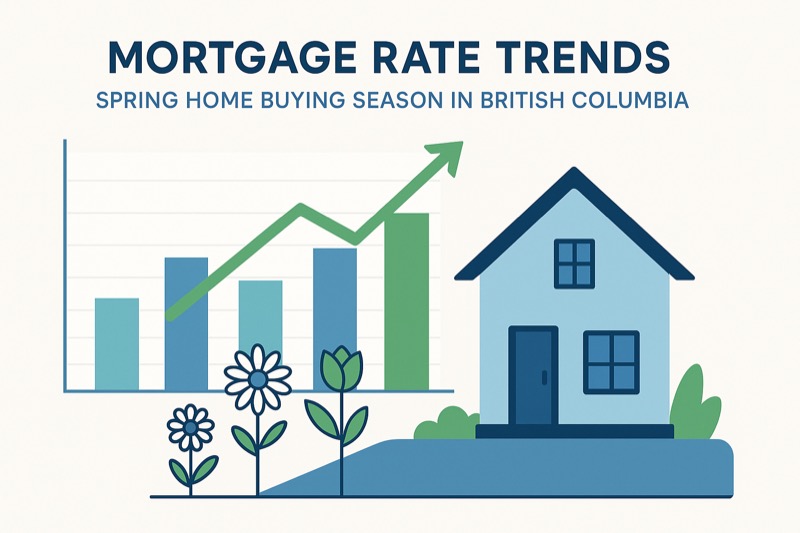
    Mortgage rate trends and spring home buying infographic for BC
    Understanding rate trends helps you time your spring purchase.

    Key Takeaways

    • Spring brings more listings but also more competition — preparation is your advantage
    • Getting pre-approved before you start shopping lets you move quickly when you find the right home
    • Current rates are more favourable than recent peaks, but planning around today’s numbers (not yesterday’s) is essential
    • A mortgage broker with local Fraser Valley knowledge can access lenders you won’t find on your own
    • Self-employed buyers have more options now through equity lending and alternative documentation programs

    How to Prepare Your Mortgage for Spring Bidding

    1. Get Pre-Approved Early

    A pre-approval isn’t just a rate hold — it confirms what you can realistically afford and signals to sellers that you’re a serious buyer. Most lenders offer 90–120 day rate holds, so getting approved in March gives you coverage through the peak spring months.

    2. Organize Your Documents Now

    Don’t wait until you find a home. Have these ready:

    • Proof of income (T4s, pay stubs, or business financials if self-employed)
    • Down payment source (90-day bank statement history)
    • ID and credit consent
    • Existing mortgage statements (if you’re selling a current home)

    3. Know Your Options Beyond A-Lending

    Not every buyer fits the standard A-lending box. If you’re self-employed, have recent credit challenges, or need faster closing, the BC market offers a structured lending landscape:

    • A-lenders (major banks and monoline lenders) — best rates, strictest criteria
    • B-lenders — more flexible on income documentation, moderate rate premium
    • Equity lenders — institutional private lenders that focus on property value rather than income or credit. These are professional, regulated operations that can close quickly — often a better option than individual private lenders for borrowers with strong equity but non-traditional income profiles
    • Private lenders — individual investors and MICs. Higher rates, used as a last resort when other options don’t fit

    Understanding where you fit helps your broker match you with the right lender from day one.

    4. Think Beyond the Purchase Price

    Closing costs in BC include property transfer tax (with first-time buyer exemptions available), legal fees, and potentially a strata document review. Budget 1.5–3% of the purchase price for these costs.

    Not sure which lender is right for your situation? Kraft Mortgages works with 100+ lenders across BC, Alberta, and Ontario. Book a free consultation and we’ll map out your options.

    Broker Field Notes: Common Spring Bottlenecks

    After 18+ years of working through Fraser Valley spring markets, here are the bottlenecks we see most often:

    1. Delayed document gathering. Clients who wait until they’ve found a home to pull together their paperwork often lose deals to faster-prepared buyers. Start collecting documents the moment you decide you’re serious about buying.
    2. Underestimating closing timelines. Spring lenders are busier. Files that might close in 2–3 weeks in January can take 3–4 weeks in April due to volume.
    3. Not having a Plan B lender. Your first-choice lender may have tighter spring criteria or slower turnaround. Having a pre-vetted backup option keeps your deal on track.
    4. Confusing equity lending with private lending. We see borrowers who think all non-bank lending is the same. Equity lenders (institutional private) are a professional option that sits between B-lenders and individual private lenders — they’re not interchangeable.

    Surrey vs. Fraser Valley: Where Prices Stand

    Surrey remains the Fraser Valley’s largest and most diverse market, with everything from condos under $500K to estate properties over $2M. Langley and Abbotsford continue to attract buyers priced out of Surrey who still want the Valley lifestyle.

    For mortgage planning, the key is matching your budget with realistic property expectations and a lender who understands local valuations. A property’s appraised value in the Fraser Valley can differ from the purchase price, especially in competitive multiple-offer situations.

    FAQ: Spring 2026 BC Mortgage Market

    Q: Is spring the best time to buy a home in Surrey?
    A: Spring offers the most inventory, which means more choices. However, competition also increases. The “best” time depends on your personal situation — if you’re ready, prepared, and pre-approved, spring can be a great time to buy. If you prefer less competition, fall and winter often have fewer buyers.

    Q: How long does mortgage pre-approval take in BC?
    A: With a licensed mortgage broker and complete documentation, pre-approval can typically be completed within 24–48 hours. Timelines vary based on the complexity of your income and credit situation.

    Q: What’s the minimum down payment in BC for 2026?
    A: For properties under $500K, the minimum is 5%. For properties between $500K and $1M, it’s 5% on the first $500K plus 10% on the portion above $500K. Properties over $1M require a minimum 20% down payment.

    Q: Can self-employed buyers get a mortgage in BC?
    A: Yes. Several lenders offer programs specifically for self-employed borrowers, including equity lenders who prioritize property value over traditional income verification. The documentation requirements differ from standard employment, so working with a broker who understands these programs is important.

    Q: Should I choose a fixed or variable rate for spring 2026?
    A: There’s no universal answer — it depends on your risk tolerance, financial situation, and how long you plan to hold the mortgage. A mortgage broker can walk you through the trade-offs based on current market conditions and your specific circumstances.

    Q: What’s the difference between a mortgage broker and a bank?
    A: A mortgage broker has access to multiple lenders (often 100+) and can shop rates and terms on your behalf. A bank offers only its own products. Brokers are particularly valuable for borrowers with non-standard income, credit challenges, or unique property types.

    Q: How do I qualify for the BC first-time home buyer property transfer tax exemption?
    A: Eligibility requirements include being a Canadian citizen or permanent resident, having lived in BC for at least one year, the property being your primary residence, and the purchase price being under $500K (with a partial exemption up to $525K). Check current BCFSA guidelines for the most up-to-date thresholds.

    Q: What happens if my purchase price is higher than the appraised value?
    A: The shortfall needs to be covered by your down payment. This is common in competitive spring markets. Discussing appraisal scenarios with your broker before making an offer can help you avoid surprises.

    Ready for Spring?

    The Fraser Valley spring market rewards prepared buyers. Whether you’re a first-time buyer in Surrey, upgrading in Langley, or exploring multi-unit options through MLI Select, having the right mortgage strategy in place before you start shopping is the best advantage you can give yourself.

    Get pre-approved before the spring rush.
    Apply Online · Call 604-593-1550 · Book a Consultation

    This article is for informational purposes only and does not constitute financial or mortgage advice. Mortgage terms, rates, and eligibility vary by lender and borrower. Consult a licensed mortgage professional for advice specific to your situation. Kraft Mortgages is licensed by BCFSA (M08001935).

  • Equity Lending in Surrey BC: Complete Guide (2026)

    Equity Lending in Surrey BC: The Complete Guide for Homeowners Who Can’t Use a Bank

    By Varun Chaudhry, Licensed Mortgage Broker — BCFSA #M08001935 | Updated March 2026

    If you’ve been turned down by your bank for a mortgage, you’re not alone. Thousands of Surrey homeowners — self-employed professionals, contractors, newcomers, people with recent credit events — face the same wall every year. The good news? There’s a professional, regulated path forward that most people don’t know about: equity lending.

    Surrey BC home equity lending

    This guide breaks down how equity lending works in Surrey BC, how it differs from traditional bank mortgages and high-rate private lending, and how to decide if it’s the right move for your situation. Everything here comes from real experience arranging mortgages across British Columbia.

    Not sure where you qualify?

    Check your options in 2 minutes — no credit check required. Run Your Free Pre-Check →

    Key Takeaways

    • Equity lending is a professional, institutional alternative to banks — it’s based on your property’s value, not your pay stubs or credit score.
    • Private mortgages and equity lending are not the same thing. Equity lenders are institutional, regulated, and typically charge significantly lower rates than individual private lenders.
    • Surrey’s real estate market — with an average detached home price well over $1 million — means many homeowners have substantial equity to work with.
    • Equity lending works best when you have a clear exit strategy: refinance later, sell the property, or improve your financial situation within 1–3 years.
    • A licensed mortgage broker can access equity lenders across Canada and negotiate terms you can’t get on your own.

    What Is Equity Lending?

    Equity lending is a type of mortgage financing where the lender’s primary decision is based on the equity in your property — the difference between what your home is worth and what you owe on it. Unlike traditional banks that scrutinize your income, employment history, and credit score, equity lenders look first at your property’s value and how much of it you own.

    This doesn’t mean your income and credit don’t matter at all. But they carry far less weight in the approval decision. The property itself is the security.

    Who Are Equity Lenders?

    Equity lenders are institutional private lenders — professionally managed companies that lend against real estate equity. They operate under British Columbia’s mortgage broker regulations, work through licensed brokers, and have structured underwriting processes.

    These are not individuals lending out of their RRSP. They’re companies with compliance departments, risk teams, and established track records. They serve a specific market: borrowers who have strong property equity but don’t fit traditional bank criteria.

    How Equity Lending Differs From Traditional Bank Mortgages

    Factor Bank (A-Lender) Equity Lender
    Primary Approval Factor Income + Credit Score Property Equity
    Income Verification Strict (T4s, NOAs, pay stubs) Flexible or not required
    Credit Score Minimum Typically 650+ Varies; equity matters more
    Processing Time 2–4 weeks (often longer) Days to 2 weeks
    Documentation Extensive Simplified
    Interest Rate Lowest available Higher than banks, lower than individual private
    Term Length 1–5 years typically Usually 1–3 years
    Best For Strong income + credit Strong equity, non-traditional income or credit challenges

    Equity Lending vs Private Lending: Why the Distinction Matters

    This is where most online guides get it wrong. They treat “private mortgage” and “equity lending” as the same thing. They’re not — and understanding the difference can save you tens of thousands of dollars.

    Equity Lenders (Institutional Private)

    • Professionally managed lending companies
    • Regulated under BC mortgage broker framework
    • Structured underwriting with clear criteria
    • Lower rates than individual private lenders
    • Longer terms available (1–3 years)
    • Accessed only through licensed mortgage brokers
    • Professional, transparent process

    Private Lenders (Individual / MIC / High-Rate)

    • Individual investors or small mortgage investment corporations
    • May or may not be fully regulated
    • Variable underwriting standards
    • Higher rates (the cost of last-resort capital)
    • Shorter terms (often 6–12 months)
    • Higher fees and brokerages
    • Appropriate when equity lenders decline the file

    The key insight: If you have decent equity in a Surrey property, you should be looking at equity lending first — not jumping straight to the highest-rate private option. A good broker will always check institutional equity lenders before considering individual private capital.

    Read the full comparison: Equity Lending vs Private Mortgages →

    Who Should Consider Equity Lending in Surrey?

    Equity lending isn’t for everyone. But for certain Surrey homeowners, it can be the difference between moving forward and being stuck. Here are the most common situations where equity lending makes sense:

    1. Self-Employed Homeowners and Business Owners

    Surrey has a thriving small business community. But if you’re self-employed — running a trucking company, a restaurant, a construction firm, or a consultancy — your tax returns probably don’t reflect your true income. Banks see your Notice of Assessment and see a lower number than your actual cash flow. Equity lenders understand this reality and weight your property’s value far more heavily than your T4 or NOA.

    2. Homeowners with Recent Credit Events

    A divorce, a business failure, a medical emergency, or a period of unemployment can damage your credit score. Banks may decline you for years afterward, even if your financial situation has recovered. Equity lenders focus on what matters now: your property’s value and your equity position.

    3. Newcomers to Canada Without Canadian Credit History

    Surrey is one of the most diverse cities in Canada. Many newcomers have significant assets and income but no Canadian credit history. Equity lending provides a path to homeownership or refinancing while they build their Canadian credit profile.

    4. Property Owners Needing Fast Financing

    Sometimes timing matters more than rate. You might need to close on a property purchase quickly, consolidate debts before rates change, or access capital for a business opportunity. Equity lenders can move faster than banks because their underwriting process is streamlined.

    5. Homeowners With Multiple Properties or Complex Situations

    Own a house in Surrey plus a rental in Abbotsford? Have a corporation that holds title to your property? Banks struggle with these structures. Equity lenders are comfortable with more complex ownership arrangements.

    How Much Equity Do You Need?

    Equity lenders in British Columbia typically want to see meaningful equity in the property — usually a minimum of 15–25% equity, depending on the property type, location, and your overall financial picture.

    For example, on a Surrey detached home valued at $1,200,000 with a current mortgage of $900,000, you’d have $300,000 in equity (25% loan-to-value if you were borrowing against the full value). This would generally be a strong equity position for an institutional equity lender.

    Loan-to-Value Ratio (LTV) is the key metric. Equity lenders calculate their risk based on what percentage of the property’s value they’re lending against. Lower LTV = lower risk = better terms.

    💡 Quick Equity Check

    Your home value minus your mortgage balance = your equity. As a rough guide, most equity lenders in BC want you to have at least 20% equity in your property. But every file is different — start a conversation with Varun to find out what’s possible.

    The Equity Lending Process: Step by Step

    Step 1: Consultation With a Licensed Mortgage Broker

    Everything starts with a conversation. A licensed broker reviews your property details, financial situation, and goals. They’ll assess your equity position, discuss your exit strategy, and determine which type of lender is the best fit. This consultation should be free and no-obligation.

    Step 2: Property Valuation

    The broker will arrange for a property valuation — typically an appraisal or a broker price opinion. This determines the current market value of your Surrey property, which directly impacts how much you can borrow and at what terms.

    Step 3: File Preparation

    Your broker will help you prepare the necessary documentation. While equity lending requires less paperwork than a bank mortgage, you’ll still need property details, mortgage statements, and identification. Income documentation may be minimal or waived depending on the lender.

    Step 4: Lender Submission and Approval

    Your broker submits your file to one or more equity lenders. Institutional equity lenders review applications quickly — often within 24–48 hours. They assess the property value, your equity position, and any other relevant factors.

    Step 5: Closing

    Once approved, your lawyer or notary handles the closing. Funds are typically disbursed within days of closing. Your broker coordinates between you, the lender, and the legal team throughout.

    Surrey Real Estate Market: Why Equity Lending Works Here

    Surrey is British Columbia’s second-largest city by population and one of its most active real estate markets. The city’s diverse neighbourhoods — from the established single-family homes of Guildford and Fleetwood to the growing communities of Clayton Heights and South Surrey — offer a wide range of property types and values.

    What makes Surrey particularly well-suited for equity lending is the significant property values combined with high ownership rates. Many Surrey homeowners have built substantial equity over years of appreciation, even if their personal financial situations have changed.

    Whether you own a detached home in Whalley, a townhouse in Newton, or a condo near Surrey Central, the equity in your property can be a powerful financial tool — if you work with the right type of lender.

    Decision Framework: Which Lender Type Is Right for You?

    Choosing the right lender type depends on your specific situation. Here’s a framework to help you think through it:

    Factor A-Lender (Bank) B-Lender Equity Lender Private Lender (Individual)
    Credit Score 650+ required 550–649 possible Flexible; equity-weighted Often not checked
    Income Documentation Full (T4s, NOAs) Stated or alternative Minimal to none Usually none
    Property Equity Needed 5–20% 15–25% 15–25% 20–35%
    Interest Rate Range Lowest Moderate Moderate-High Highest
    Processing Speed 2–4+ weeks 1–3 weeks 3–10 business days 24 hours – 1 week
    Typical Term 1–5 years 1–3 years 1–3 years 6–12 months
    Exit Strategy Required No Preferred Yes, strongly Yes, mandatory
    Best For Strong income + credit Moderate credit challenges Strong equity, income/credit gaps Extreme urgency, last resort

    The recommended approach: Always start with the most favourable option and work down. A licensed mortgage broker can run your file through A-lenders first, then B-lenders, then equity lenders, then private lenders — and show you exactly what each one offers so you can make an informed decision.

    🤝 Work With a Broker Who Knows Equity Lending

    Varun has arranged thousands of mortgages across BC, Alberta, and Ontario — including equity lending for Surrey homeowners. Start Your Application Online →

    Scenario Example: Using Equity Lending to Refinance and Rebuild

    Note: This is a fictionalized example for illustration purposes only. It is not a promise of any specific outcome, rate, or approval. Every mortgage application is evaluated individually based on its own merits.

    The situation: Raj and Priya own a detached home in Fleetwood, Surrey. They purchased it eight years ago for $780,000. The home is now worth approximately $1,250,000. Their current mortgage balance is $620,000. Their combined equity position is roughly $630,000.

    The problem: Raj runs a landscaping business. His income fluctuates seasonally, and his tax returns show lower net income than his actual cash flow. Priya recently returned to work after a medical leave, and they accumulated $45,000 in credit card and line of credit debt during that time. Their credit scores dropped to the low 600s.

    The bank said no. Their income documentation didn’t meet the bank’s stress test requirements, and the credit card balances pushed their debt ratios too high.

    The equity lending solution: They worked with their mortgage broker, who submitted their file to an institutional equity lender. The lender approved a first mortgage refinance at a competitive rate (lower than individual private lender rates) based primarily on the $630,000 of equity in their property. The new mortgage paid out their existing mortgage and all $45,000 of high-interest debt.

    The exit strategy: Raj and Priya plan to use the next 24 months to pay down debt, rebuild their credit scores, and build a stronger income paper trail. Their broker will then help them refinance into a lower-rate A-lender or B-lender product when they qualify.

    Common Uses for Equity Lending

    Debt Consolidation

    Paying off high-interest credit cards, lines of credit, and personal loans with a single mortgage payment. This can significantly reduce monthly carrying costs and simplify finances.

    Property Purchase

    Buying a home when you can’t qualify for bank financing — whether it’s your first home, an investment property, or a recreational property.

    Renovation Financing

    Accessing your property’s equity to fund renovations that increase the home’s value. This can be particularly effective for creating a legal suite in Surrey, where basement suites are common and add significant rental income potential.

    Business Capital

    Self-employed homeowners often use equity lending to access business capital when traditional business loans aren’t available or are too slow.

    Bridge Financing

    Short-term financing to bridge the gap between buying a new property and selling an existing one.

    Broker Field Notes: What We Actually See in Surrey Files

    After years of arranging mortgages across Surrey and the Lower Mainland, here are some patterns we see regularly. These are general observations from our practice — not guarantees or predictions about any specific file.

    Self-Employment Is the #1 Reason for Equity Lending

    The majority of equity lending files we handle involve self-employed borrowers. Surrey’s entrepreneurial culture means there are thousands of business owners, contractors, and gig workers who earn well but don’t have the clean T4 income that banks demand. The gap between actual cash flow and what appears on a Notice of Assessment is often significant.

    Many Borrowers Don’t Know Equity Lending Exists

    A surprising number of clients come to us after being declined by their bank and assuming they have no options. Some have already received quotes from individual private lenders at very high rates — not realizing that institutional equity lending exists as a middle ground. Education is a big part of what we do.

    The Exit Strategy Matters More Than People Think

    Equity lending is almost always a stepping stone, not a long-term solution. The borrowers who have the best outcomes are those who enter with a clear plan: “I’ll use this equity loan for 18 months, pay down my debts, and then refinance into a conventional mortgage.” Without an exit strategy, borrowers risk getting stuck in a cycle of short-term, higher-cost financing.

    Surrey’s Property Values Work in Your Favour

    The appreciation in Surrey real estate over the past decade has created substantial equity positions for many homeowners. Even borrowers who bought relatively recently may find they have enough equity to qualify for institutional equity lending, especially in desirable neighbourhoods.

    Timing Can Be Critical

    We’ve seen files where clients waited too long — letting debts grow or credit scores drop further — before seeking help. The earlier you explore your options with a broker, the more choices you’ll have. Equity lending is a tool; like any tool, it works best when used at the right time.

    Risks and Considerations

    Equity lending is a powerful tool, but it’s not without risks. Here’s what every borrower should understand:

    Higher Rates Than Banks

    Equity lenders charge more than traditional banks. This is the cost of more flexible approval criteria and faster processing. You need to be comfortable with the monthly payment at the equity lending rate.

    Shorter Terms

    Equity loans typically have terms of 1–3 years. This means you’ll need to renew or refinance sooner than with a conventional mortgage. If rates are higher when you renew, your payments could increase.

    Fees and Costs

    There are fees associated with equity lending — lender fees, broker fees (where applicable), appraisal costs, and legal fees. These should be clearly disclosed upfront and factored into your decision.

    Your Property Is at Risk

    As with any mortgage, failure to make payments can result in foreclosure. This risk is real and should be taken seriously. Borrow only what you need and ensure you can afford the payments.

    Exit Strategy Dependency

    If your exit strategy doesn’t work out — for example, if you can’t refinance into a bank product within your term — you may need to renew with the equity lender at prevailing rates, which could be higher than your initial rate.

    How to Choose the Right Mortgage Broker for Equity Lending

    Not all mortgage brokers have experience with equity lending. Here’s what to look for:

    • Experience with private and equity lending: Ask how many equity lending files they’ve handled. This isn’t something you want to be a broker’s first attempt at.
    • Access to multiple equity lenders: A good broker has relationships with several institutional equity lenders and can shop your file to find the best fit.
    • Licensing across multiple provinces: If you own property in BC and Alberta (or Ontario), a broker licensed in all three provinces can manage your entire portfolio.
    • Transparent about fees and rates: Your broker should explain all costs upfront — no surprises at closing.
    • Focuses on your exit strategy: A broker who’s only thinking about getting you approved today isn’t serving you well. The best brokers plan for your refinance or transition to better terms.

    Equity Lending in Surrey: Neighbourhood Considerations

    Surrey’s diverse real estate market means equity lending can look different depending on where your property is located:

    Fleetwood and Guildford

    Established neighbourhoods with strong property values and consistent demand. These areas typically offer the most favourable equity lending terms due to reliable resale values.

    Whalley and City Centre

    Surrey’s urban core has seen significant development and appreciation. Condos and townhouses here are common equity lending subjects, and the area’s growth trajectory supports property values.

    Clayton Heights and South Surrey

    Family-oriented neighbourhoods with newer homes and strong school catchments. These properties tend to hold their value well, which equity lenders view favourably.

    Newton and Cloverdale

    Mixed housing stock with a range of price points. Equity lending options here depend heavily on the specific property and its condition.

    Frequently Asked Questions

    What credit score do I need for equity lending in Surrey?

    There’s no universal minimum credit score for equity lending. Institutional equity lenders primarily evaluate your property’s equity position, your overall financial picture, and your exit strategy. Some equity lenders will work with borrowers who have credit scores below 600, while others may have higher thresholds. Every lender has different criteria, which is why working with a broker who has access to multiple equity lenders is important — they can match your file to the right lender.

    How fast can I get approved for an equity loan?

    Approval timelines vary, but institutional equity lenders can often provide conditional approval within 24–48 hours of receiving a complete file. Closing can typically happen within 3–10 business days, depending on appraisal scheduling and legal processing. This is significantly faster than traditional bank approvals, which can take several weeks.

    Can I get an equity loan if I’m self-employed with no T4 income?

    Yes, this is one of the most common reasons Surrey homeowners use equity lending. Institutional equity lenders understand that self-employed income doesn’t always show up cleanly on tax returns. While some equity lenders may request bank statements or business financials to demonstrate cash flow, the primary approval factor remains your property’s equity. Many self-employed borrowers are approved with minimal income documentation.

    Is equity lending the same as a private mortgage?

    No. While both fall under the broader category of non-bank lending, equity lending and private lending are distinct. Equity lenders are institutional companies with professional underwriting, regulatory compliance, and typically lower rates than individual private lenders. Private lenders are often individual investors or small mortgage funds that charge higher rates for higher-risk files. Equity lending is generally the preferred first step when bank financing isn’t available. You can read more about the differences in our equity lending vs private mortgages guide.

    What happens when my equity loan term ends?

    When your equity loan term ends (typically after 1–3 years), you’ll need to either renew the loan, refinance with a different lender, or pay it out. This is why having an exit strategy from the beginning is so important. Many borrowers use the equity loan term to improve their financial situation — paying down debts, rebuilding credit, or building income documentation — so they can qualify for a lower-rate conventional mortgage when the term expires.

    Can I use equity lending to buy an investment property in Surrey?

    Yes, equity lending can be used for investment property purchases. However, equity lenders may have different loan-to-value requirements for investment properties compared to owner-occupied homes. Investment properties typically require more equity (lower LTV) because of the higher risk profile. Your broker can advise on the specific requirements for your situation.

    How much does equity lending cost in fees?

    Equity lending involves several costs: lender fees (varies by lender), appraisal fees (typically $300–$600), legal fees for closing, and potentially broker fees depending on the arrangement. All costs should be disclosed to you upfront before you commit to any lender. A good broker will provide a complete breakdown of all fees so you can compare your total cost of borrowing across different options.

    Can I refinance from an equity loan into a bank mortgage later?

    Yes, this is the most common exit strategy. Many borrowers use equity lending as a bridge — getting approved based on their property equity today, then refinancing into a conventional bank mortgage once their income documentation, credit score, or debt ratios have improved. The timeline for this transition varies, but many borrowers are able to qualify for bank financing within 12–24 months with disciplined financial management.

    What’s the maximum I can borrow with equity lending?

    The amount you can borrow depends primarily on your property’s value and the lender’s maximum loan-to-value ratio. Most institutional equity lenders in BC will lend up to 70–80% of your property’s appraised value, depending on the property type, location, and your overall situation. The exact amount varies by lender and file, so it’s best to have a broker assess your specific property and equity position.

    Do I need an appraisal for equity lending?

    Yes, nearly all equity lenders require a property valuation. This is typically an appraisal conducted by a licensed appraiser, though some lenders may accept a broker price opinion depending on the loan size and property type. The appraisal protects both you and the lender by establishing an objective market value for the property.

    Renewing Your Surrey Mortgage? This Matters Too

    If you’re approaching your mortgage renewal date in 2026, the Bank of Canada’s current rate hold policy may affect your renewal options — especially if your financial situation has changed since you originally qualified. Equity lending can be a safety net if your renewal with your current lender is declined or offered at unfavourable terms.

    Read our Surrey Mortgage Renewal Guide for 2026 →

    Equity Lending Across Western Canada

    While this guide focuses on Surrey, equity lending works similarly across British Columbia and Alberta. If you own property in both provinces — a common situation for investors and business owners — working with a broker licensed in both BC and Alberta can simplify the process significantly.

    Learn about private and equity lending in Surrey and Alberta →

    Ready to Explore Your Equity Lending Options?

    Whether you’re self-employed, dealing with credit challenges, or need financing fast — let’s see what’s possible with your property’s equity.

    Free Pre-Check Apply With Varun

    Disclaimer

    The information in this article is for general educational purposes only and does not constitute financial or mortgage advice. Every mortgage application is evaluated individually based on its own merits. Interest rates, approval criteria, and terms vary by lender and are subject to change without notice. The scenario example provided is fictionalized and is not a promise or guarantee of any specific outcome. Always consult with a licensed mortgage broker to discuss your specific situation. Kraft Mortgages is licensed by the British Columbia Financial Services Authority (BCFSA #M08001935).

    (BCFSA #M08001935).

  • First-Time Home Buyer’s Guide to Surrey BC 2026: Programs, Down Payments, and Step-by-Step Instructions

    First-Time Home Buyer’s Guide to Surrey BC 2026: Programs, Down Payments, and Step-by-Step Instructions

    Buying your first home in Surrey in 2026 is more achievable than it has been in years — but only if you know how to use every tool available to you. Between provincial tax exemptions, federal savings accounts, and RRSP withdrawal programs, there are thousands of dollars in savings that most first-time buyers simply do not know about. Some leave $14,700 on the closing table because they did not fill out a single form.

    At Kraft Mortgages Canada Inc., we have managed over $5 billion in mortgage originations and spent 18+ years helping first-time buyers across Surrey, the Fraser Valley, and Greater Vancouver navigate the purchase process. We see the same mistakes over and over: buyers who wait too long to get pre-approved, who do not understand the programs available to them, or who think they need a 20% down payment when 5% is enough. This guide covers everything you need to know, step by step, with real numbers for the Surrey market.

    The 2026 Market: Why This Year Is Different

    Time to read: 2 min

    Let us start with the good news. After three years of punishing rate hikes and declining affordability, the 2026 Surrey market has shifted in favour of buyers:

    • Prices have corrected to late-2021 levels. The Fraser Valley composite benchmark sits at $895,100 (February 2026) — down 7.7% year-over-year. Surrey condos benchmark at $494,100 and townhomes at $767,000.
    • Inventory is elevated. More homes on the market means less competition. Bidding wars, which were the norm in 2021-2022, are now the exception rather than the rule in most Surrey neighbourhoods.
    • Rates are stable. The Bank of Canada has held the overnight rate at 2.25% for three consecutive meetings. Five-year fixed rates are around 4.69%, and 30-year amortizations are now available for first-time buyers with insured mortgages.
    • Forecast: 3-6% price growth in 2026. Analysts expect prices to start climbing again as immigration-driven demand absorbs the current inventory. The window to buy at corrected prices may be closing.

    The bottom line: if you have been waiting for a better time to buy your first home in Surrey, this is it. The combination of lower prices, more inventory, stable rates, and expanded government programs makes 2026 the most favourable environment for first-time buyers in over four years.

    Young couple holding keys in front of a beautiful new Surrey BC townhome


    Step 1: Understand Your Down Payment Options

    Time to read: 2 min

    The biggest myth in Canadian real estate is that you need 20% down to buy a home. You do not. Here is what you actually need:

    Home Price Minimum Down Payment What This Means
    Up to $500,000 5% ($25,000) Full 5% down
    $500,001 – $999,999 5% on first $500K + 10% on remainder On a $650K home: $40,000
    $1,000,000+ 20% ($200,000+) No mortgage insurance below this

    For a typical Surrey townhouse at $750,000, the minimum down payment is $50,000 (5% on the first $500K plus 10% on the remaining $250K). With CMHC mortgage loan insurance added to your mortgage balance, your total mortgage would be approximately $727,000 (including the CMHC premium).

    The 30-year amortization advantage: As of late 2024, first-time buyers purchasing newly built homes with insured mortgages can now stretch their amortization to 30 years (up from the standard 25). This can reduce your monthly payment by 10-15% — potentially saving you $300-$500 per month on a $750,000 mortgage. Not all lenders offer this yet, which is another reason to work with a mortgage broker in Surrey who knows which lenders have adopted the policy.

    Use our affordability calculator to see exactly how much home you can afford with your current savings.


    Step 2: Maximize Every Government Program Available

    Time to read: 4 min

    This is where most first-time buyers leave money on the table. Here is every program available to you in 2026, with real dollar amounts:

    BC First-Time Home Buyer Exemption (Property Transfer Tax)

    When you buy a home in BC, you normally pay Property Transfer Tax: 1% on the first $200,000 and 2% on the remainder. On a $750,000 home, that is $13,000. But as a first-time buyer, you may qualify for a full or partial exemption:

    • Full exemption: Homes valued up to $835,000 — you pay $0 in PTT. That is $13,000+ saved at closing.
    • Partial exemption: Homes between $835,001 and $860,000 — you pay a reduced amount.
    • Newly Built Home Exemption: If you are buying a brand-new home (presale or newly completed), the threshold is even higher: full exemption up to $1,100,000, partial up to $1,150,000.

    Eligibility requirements: You must be a Canadian citizen or permanent resident, have lived in BC for at least 12 months (or filed 2 BC tax returns in the past 6 years), and must never have owned a principal residence anywhere in the world. The property must be your principal residence within 12 months of registration.

    First Home Savings Account (FHSA)

    The FHSA is the most powerful savings tool for first-time buyers — and most Canadians still do not know it exists. Think of it as the love child of an RRSP and a TFSA:

    • Contribute up to $8,000 per year (lifetime maximum $40,000)
    • Contributions are tax-deductible — just like an RRSP. If you earn $80,000, an $8,000 FHSA contribution saves you roughly $1,800 in taxes.
    • Withdrawals for a first home are tax-free — just like a TFSA. No repayment required.
    • If you do not buy: Transfer to your RRSP or RRIF without penalty.
    • Unused room carries forward — max $8,000/year. You can contribute up to $16,000 in year two if you missed year one.

    A couple can save up to $80,000 combined through two FHSAs. Combined with the Home Buyers’ Plan below, that is potentially $200,000 in total down payment funds for a household.

    Home Buyers’ Plan (RRSP Withdrawal)

    You can withdraw up to $60,000 from your RRSP ($120,000 for a couple) to use as a down payment. The money must have been in your RRSP for at least 90 days before withdrawal. You repay it over 15 years, starting in the fifth year after withdrawal — roughly $333/month on a $60,000 withdrawal.

    Strategy: Use the FHSA first (no repayment required), then top up with the HBP if you need more.

    Federal First-Time Home Buyer Tax Credit (HBTC)

    A non-refundable tax credit of $10,000, which translates to $1,500 in tax savings (at the 15% federal rate) in the year you buy your first home. Claim it on Line 31270 of your T1 return. Every bit helps at closing.

    BC Home Owner Grant

    Reduces your annual property taxes by up to $570 in Metro Vancouver and the Fraser Valley (up to $770 in rural/northern areas). The grant begins phasing out for homes assessed above $2,175,000. Not exclusive to first-time buyers, but worth knowing about.

    Total potential savings for a Surrey first-time buyer:

    Program Maximum Savings
    BC PTT Exemption $14,700
    FHSA (individual, 5 years) $40,000 + tax savings
    HBP (RRSP withdrawal) $60,000 (repayable)
    Federal HBTC $1,500
    BC Home Owner Grant (annual) $570/year

    Professional reviewing mortgage documents at a modern kitchen counter with warm natural light


    Step 3: Get Pre-Approved Before You Start Shopping

    Time to read: 2 min

    This is the single most important step — and the one most buyers skip or rush. A pre-approval tells you exactly how much a lender will lend you, at what rate, and locks that rate for up to 120 days. Without it, you are shopping blind.

    What happens at pre-approval:

    1. Credit check. The lender pulls your credit score. For insured mortgages (less than 20% down), you typically need a minimum score of 600-640, though some lenders accept 580.
    2. Income verification. Employment letters, pay stubs, T4s, or tax returns (more documentation if self-employed).
    3. Debt service ratios. The lender checks that your total housing costs (mortgage + property tax + heating + 50% of strata fees) stay below 39% of your gross income (GDS), and that your total debt (housing + all other debts) stays below 44% (TDS).
    4. Rate hold. You lock in today’s rate for 120 days. If rates drop during that period, most lenders let you capture the lower rate.

    Why you should use a broker for pre-approval: A bank will only show you their products. A mortgage broker in Surrey shops 50+ lenders and finds the best rate and product for your specific situation. The difference between the best and worst rate on a $750,000 mortgage can be $200-$400 per month — that is $24,000-$48,000 over a 5-year term.

    Get pre-approved today and know your budget before you fall in love with a home you cannot afford.


    Step 4: What $600K-$800K Actually Buys in Surrey Right Now

    Time to read: 2 min

    Based on March 2026 market data, here is what your money gets you across different property types in Surrey:

    Budget Condo Townhouse
    $500K-$600K 1-2 bed, 600-850 sq ft (Guildford, Newton) 2 bed, 1,000-1,200 sq ft (Newton, Cloverdale)
    $600K-$700K 2-3 bed, 800-1,000 sq ft (Guildford, Fleetwood) 3 bed, 1,200-1,400 sq ft (Cloverdale, Newton)
    $700K-$800K 2-3 bed, 900-1,100 sq ft, newer builds 3-4 bed, 1,400-1,600 sq ft (all neighbourhoods)
    $800K+ Premium units, penthouses, waterfront New build, 1,500+ sq ft, attached garage

    Monthly payment estimates (10% down, 4.49% 5-year fixed, 25-year amortization, including estimated property taxes and strata):

    • $550,000 condo: approximately $3,200/month
    • $650,000 townhouse: approximately $3,750/month
    • $750,000 townhouse: approximately $4,300/month

    These numbers assume CMHC insurance and standard closing costs. Use our payment calculator to get precise figures for your situation.


    Step 5: The Closing Process — What No One Tells You

    Time to read: 2 min

    Most first-time buyers focus entirely on getting approved and making an offer, then get blindsided by closing costs. Here is what to budget for beyond your down payment:

    • Property Transfer Tax: $0 if you qualify for the first-time buyer exemption (homes up to $835,000). Otherwise, 1% on first $200K + 2% on remainder.
    • CMHC Insurance Premium: 2.4-4.0% of the mortgage amount (added to your mortgage, not paid upfront). On a $700,000 mortgage with 5% down, the premium is approximately $27,300.
    • Legal/Notary Fees: $1,500-$2,500 for conveyance.
    • Property Inspection: $400-$800 for a pre-purchase inspection.
    • Title Insurance: $300-$500.
    • Home Insurance: $100-$200/month (required before closing).
    • Strata Document Review: $200-$350 (for condos/townhouses).
    • Adjustments: Property tax and utility adjustments — typically $500-$2,000 depending on when you close.

    Total closing costs budget: Expect to spend $3,000-$5,000 beyond your down payment if you qualify for the PTT exemption, or $16,000-$19,000 if you do not. This is why the PTT exemption is so valuable — it can eliminate the single largest closing cost entirely.


    Step 6: First-Time Buyer Mistakes That Cost Thousands

    Time to read: 2 min

    After helping thousands of first-time buyers, here are the mistakes we see repeatedly:

    1. Not getting pre-approved. Shopping without a pre-approval means you do not know your budget, and sellers may not take your offer seriously. Get pre-approved first — it takes 15 minutes and costs nothing.
    2. Forgetting about the PTT exemption. We have seen buyers budget $13,000 for PTT when they could have qualified for a full exemption. The form takes 5 minutes to file with your lawyer or notary at closing.
    3. Not opening an FHSA. Every year you delay costs you $8,000 in contribution room and potential tax savings. Open one today, even if you are not buying for 2-3 years.
    4. Using all your savings for the down payment. Keep a $5,000-$10,000 emergency fund. Closing always costs more than you expect, and you will want a buffer for moving costs, furniture, and unexpected repairs.
    5. Ignoring strata documents. For condos and townhouses, review the strata minutes, financial statements, and engineering reports before making an offer. A $500/month special assessment you did not know about can destroy your budget.
    6. Going with the first lender you talk to. A bank will offer you one rate. A broker will show you 50+. On a $700,000 mortgage, even a 0.2% rate difference saves you $90/month or $5,400 over 5 years.

    Frequently Asked Questions

    I have bad credit. Can I still buy my first home?
    It depends on how bad. For CMHC-insured mortgages, the minimum credit score is 600 (some lenders accept 580). If your score is below that, you may need to work with a B-lender or private lender at a higher rate while you rebuild your credit. At Kraft Mortgages, we work with lenders at every tier and can help you create a credit-rebuilding plan that gets you mortgage-ready within 6-12 months.

    I am self-employed. What documents do I need?
    If you have been self-employed for 2+ years, most A-lenders will want your T1 Generals, Notices of Assessment, and business financial statements. If you have been self-employed for less than 2 years, or if your income is irregular, we work with alternative lenders who accept bank statements or stated income. You have more options than you think — talk to us about self-employed mortgage solutions.

    Can I use the FHSA and the Home Buyers’ Plan together?
    Absolutely. They are separate programs. You can save $40,000 in an FHSA AND withdraw $60,000 from your RRSP through the HBP — a couple can combine both for up to $200,000 in down payment funds.

    What if I owned a home outside Canada?
    The BC PTT first-time buyer exemption requires that you have never owned a principal residence anywhere in the world. If you previously owned a home in another country, you will not qualify for the exemption — but you may still qualify for the federal HBTC and FHSA, which use different definitions.

    How long does the whole process take?
    From pre-approval to keys in hand, a typical first-time purchase in Surrey takes 30-90 days. Pre-approval takes 1-3 business days. House hunting can take weeks to months (but with current inventory, homes are sitting longer). Once your offer is accepted, closing typically takes 30-60 days for a resale property, or longer for a presale.


    Ready to Start? Let Us Guide You

    Buying your first home is one of the most important financial decisions of your life — and it should not be overwhelming. At Kraft Mortgages Canada Inc., we have guided thousands of first-time buyers through the process, from pre-approval to closing and beyond. We are licensed in BC, Alberta, and Ontario, and we work with 50+ lenders to find you the best rate and product for your unique situation.

    Your first step is simple:

    Do not wait for the market to shift again. The programs are generous, the inventory is there, and the rates are stable. Your first home is closer than you think — let us help you get there.

  • Best Surrey Neighbourhoods for First-Time Buyers 2026: Cloverdale vs Newton vs Fleetwood vs Guildford

    Buying your first home in Surrey used to feel impossible. Between sky-high detached prices and bidding wars on anything with a yard, an entire generation of Fraser Valley renters spent years watching the dream slip further away. But something has shifted in 2026. Inventory is up. Prices have softened to late-2021 levels. And for the first time in years, first-time buyers with a $600,000-$800,000 budget actually have options.

    The question is no longer “can I afford to buy in Surrey?” It is “which Surrey neighbourhood is right for me?” At Kraft Mortgages Canada Inc., where we have managed over $5 billion in mortgage originations and spent 18+ years helping first-time buyers navigate the Fraser Valley market, we know that choosing the right neighbourhood is just as important as choosing the right mortgage. Here is your complete guide to the four best Surrey neighbourhoods for first-time buyers — with real numbers, real developments, and honest assessments.

    Surrey First-Time Buyer Programs You Might Be Leaving Money On

    Time to read: 2 min

    Before we dive into neighbourhoods, make sure you are not leaving free money on the table. British Columbia and the federal government offer programs that can save you tens of thousands on your first purchase:

    Program Savings Eligibility
    BC PTT Exemption Up to $14,700 Homes up to $835,000 (partial up to $860,000)
    FHSA (First Home Savings Account) Up to $40,000 tax-free $8,000/year contribution, tax-deductible
    Home Buyers’ Plan (RRSP) Up to $60,000 withdraw Repay over 15 years, couples can double it
    First-Time Home Buyer Tax Credit Up to $1,500 Non-refundable credit in year of purchase

    A couple maxing out both FHSA accounts and the Home Buyers’ Plan could have $200,000 in combined down payment funds. That is enough for a 25% down payment on an $800,000 home — which also means you skip CMHC insurance premiums entirely. Use our pre-approval calculator to see how these programs affect your purchasing power.

    Beautiful aerial view of Surrey BC neighbourhoods at golden hour with tree-lined streets and distant mountains


    Cloverdale: The Best Value Play in Surrey Right Now

    Time to read: 3 min

    If you have driven through Cloverdale recently, you know the neighbourhood is transforming. What was once a quiet rural-adjacent community anchored by the Cloverdale Rodeo grounds has become one of Surrey’s fastest-growing residential areas, with new townhome and condo developments filling in along 176th Street, 64th Avenue, and the Highway 10 corridor.

    What $600K-$800K buys you in Cloverdale (March 2026):

    Property Type Price Range What You Get
    Condo (1-2 bed) $275K – $550K 500-900 sq ft, newer builds, some with parking
    Townhouse (2-3 bed) $469K – $825K 1,100-1,500 sq ft, modern open concept, some with yards
    Older detached $850K – $1.1M 1,500-2,000 sq ft, 1960s-1980s builds, needs updates

    Why Cloverdale works for first-time buyers:

    • Affordability sweet spot. Cloverdale townhouses consistently sell for 10-15% less than comparable units in Fleetwood or Guildford. A new 3-bedroom townhouse here starts around $650,000 — well within the BC PTT exemption limit of $835,000.
    • Community feel. Wide streets, established schools (Cloverdale Elementary, Lord Tweedsmuir Secondary), and the annual Cloverdale Rodeo give this neighbourhood a small-town character that is rare in Metro Vancouver.
    • Future transit. The planned Surrey-Langley SkyTrain extension along Fraser Highway will run directly through Cloverdale. Properties near future stations are likely to see significant appreciation when the line opens.

    Watch out for: Highway 10 traffic can be heavy during rush hour, and some parts of Cloverdale still feel underdeveloped. Stick to the areas north of 64th Avenue and west of 184th Street for the best access to amenities and transit.

    Monthly payment estimate (725K townhouse, 10% down, 4.49% fixed): $3,760/month including property tax estimates. Use our payment calculator to fine-tune for your specific situation.


    Newton: The Bold Choice for Budget-Conscious Buyers

    Time to read: 3 min

    Newton gets a bad reputation in Surrey — much of it undeserved. The truth is that Newton offers some of the most affordable townhouses and condos in the entire city, and the neighbourhood is undergoing a slow but steady transformation as new developments replace older stock along 72nd Avenue, 128th Street, and Scott Road.

    What $600K-$800K buys you in Newton (March 2026):

    Property Type Price Range What You Get
    Condo (2-3 bed) $589K – $695K 750-1,000 sq ft, newer 2026 builds available
    Townhouse (2-4 bed) $669K – $820K 1,200-1,500 sq ft, new construction, modern finishes
    Detached (older) $900K – $1.1M 1,800-2,200 sq ft, larger lots, potential for suites

    Why Newton deserves a second look:

    • Unbeatable townhouse prices. A brand-new 3-bedroom townhouse in Newton can be yours for under $820,000. The same unit in Fleetwood would cost $50,000-$100,000 more. That difference means a smaller mortgage, lower monthly payments, or a bigger down payment.
    • Scott Road SkyTrain access. The Newton Exchange is already a major transit hub with regular SkyTrain service to Surrey Central and beyond. For buyers who commute to Vancouver or Burnaby, Newton offers some of the best transit connectivity in Surrey.
    • Diversity of amenities. Newton has everything: Guildford Town Centre is minutes north, Strawberry Hill shopping district has grocery stores, restaurants, and services, and the area is home to some of Surrey’s best South Asian dining and cultural venues.

    Watch out for: Property crime rates in parts of Newton are higher than the Surrey average. Before buying, visit the neighbourhood at different times of day and talk to neighbours. Also, older condo buildings along Scott Road may have deferred maintenance — always review the strata minutes before making an offer.

    Monthly payment estimate (750K townhouse, 10% down, 4.49% fixed): $3,890/month. Check your budget with our affordability calculator.


    Fleetwood: Where Families Are Landing

    Time to read: 3 min

    If Cloverdale is the value play and Newton is the bold choice, Fleetwood is the safe bet. Consistently ranked as one of Surrey’s most family-friendly neighbourhoods, Fleetwood combines strong schools, parks, and a growing commercial corridor along Fraser Highway with new townhome developments that are attracting young families in droves.

    What $600K-$800K buys you in Fleetwood (March 2026):

    Property Type Price Range What You Get
    Condo (1-2 bed) $450K – $650K 600-900 sq ft, newer buildings, near Fraser Hwy
    Townhouse (3-4 bed) $599K – $900K 1,200-1,500 sq ft, new builds, attached garages
    Detached (older) $1.05M – $1.35M 1,800-2,500 sq ft, 1990s-2000s builds

    Why first-time buyers love Fleetwood:

    • Top-rated schools. Fleetwood is home to some of Surrey’s best public schools, including Fleetwood Park Secondary and ecole Salish Secondary. For families with young children, school catchment areas are often the deciding factor — and Fleetwood delivers.
    • New construction abundance. The Fleetwood Tynehead area has seen a surge of new townhome developments in 2025-2026, with 3-bedroom units starting around $820,000. These homes feature modern finishes, energy-efficient construction, and attached garages — everything a growing family needs.
    • Nature access. Tynehead Regional Park, Green Timbers Urban Forest, and the Serpentine River greenway are all within walking or cycling distance. If outdoor recreation matters to you, Fleetwood is hard to beat.

    Watch out for: Fleetwood is one of the more expensive options on this list. With a median home price of $994,165, you will be stretching the upper end of a $600K-$800K budget to find a townhouse here. The detached market is largely out of reach for first-time buyers unless you have significant equity or family help.

    Monthly payment estimate (850K townhouse, 10% down, 4.49% fixed): $4,400/month. See how that fits your budget with our debt consolidation calculator to free up cash flow.

    Young family walking through a Surrey BC park with townhomes and cherry blossoms


    Guildford: The Urban First-Time Buyer’s Neighbourhood

    Time to read: 3 min

    Guildford is Surrey’s answer to urban living. Anchored by Guildford Town Centre (one of the Lower Mainland’s largest malls), the neighbourhood offers condo living with walkable access to shopping, dining, transit, and entertainment. For first-time buyers who want city convenience without Vancouver prices, Guildford is the most compelling option in Surrey.

    What $600K-$800K buys you in Guildford (March 2026):

    Property Type Price Range What You Get
    Condo (1-3 bed) $400K – $750K 420-1,130 sq ft, modern towers, full amenities
    Townhouse (3-4 bed) $700K – $950K 1,300-1,700 sq ft, newer builds, near transit
    Detached $1.1M+ Largely out of reach for first-time buyers

    New presale developments completing in 2026:

    • Zenith Guildford (14297 103A Ave) — Studios to 3-bedrooms, 419-1,134 sq ft. Move-in ready 2026. Amenities include rooftop terrace, gym, and community hall. Walkable to Guildford Town Centre and Real Canadian Superstore.
    • Guilden Guildford (14683 104 Ave) — 187 condos across two 6-storey buildings. Fall 2026 move-in for Building 1. Studios to 2-bedrooms with penthouse options. Indoor lounge, billiards, fitness studio, EV-ready parking.
    • Guildford The Greatest 2 (Dawson + Sawyer) — 1-3 bedroom homes, mid-2026 move-in. Modern family-focused design near Guildford Town Centre, schools, and parks.
    • The Great One Townhomes — 3-4 bedroom shingle-style townhomes near Lionel Courchene Park. Spacious layouts with attached garages.

    Why Guildford is the smart urban choice:

    • Presale opportunities. Buying presale in Guildford lets you lock in today’s prices with a smaller initial deposit (typically 5-10%), with the balance due on completion. If prices appreciate between now and 2027-2028, you could walk into equity on day one.
    • SkyTrain access. Guildford is already connected via the Expo Line to Surrey Central, New Westminster, and downtown Vancouver. A commute to Waterfront Station takes roughly 45 minutes — faster than driving from many parts of Vancouver itself.
    • Investment potential. Guildford condos and townhomes near the SkyTrain have strong rental demand. If you plan to live in the unit for 3-5 years and then rent it out, this neighbourhood offers some of the best cap rates for new construction in Surrey.

    Watch out for: Newer presale condos can carry higher strata fees ($350-$500/month) due to full amenity packages. And presale purchases carry risk — if the market softens before completion, you could end up with a property worth less than you contracted to pay. Work with a mortgage broker in Surrey who understands presale financing to structure your purchase correctly.

    Monthly payment estimate (650K condo, 10% down, 4.49% fixed): $3,375/month. Compare your options with our payment calculator.


    The Head-to-Head: Which Neighbourhood Wins?

    Time to read: 1 min

    Factor Best Pick Runner-Up
    Lowest price Newton Cloverdale
    Best schools Fleetwood Cloverdale
    Best transit Guildford Newton
    Most new builds Guildford Fleetwood
    Best value (price vs. quality) Cloverdale Newton
    Most family-friendly Fleetwood Cloverdale
    Best investment potential Guildford Cloverdale
    Biggest upside (SkyTrain coming) Cloverdale Newton

    The honest answer is that there is no single “best” neighbourhood — there is the best neighbourhood for you. A young professional commuting to Vancouver should look at Guildford. A family with two kids and a dog should prioritize Fleetwood or Cloverdale. A buyer with a strict $650,000 budget will find more options in Newton than anywhere else.


    Frequently Asked Questions

    Can I really buy a home in Surrey with $60,000 down?
    Yes. With $60,000 down (approximately 8-10% on a $600K-$750K property), you can purchase a condo in Guildford, a townhouse in Newton, or a condo in Fleetwood. You will pay CMHC insurance (2.4-4.0% of the mortgage amount), which gets added to your mortgage balance. At today’s rates, expect monthly payments between $3,200-$3,800 depending on the property.

    Should I buy a presale or a resale property?
    Presales offer newer construction and the ability to customize finishes, but they come with completion risk and sometimes higher strata fees. Resale properties allow you to see exactly what you are buying, negotiate price and conditions, and move in immediately. For most first-time buyers, a resale townhouse is the safer bet unless you are confident in the developer and have a long-term hold strategy.

    How much do I need to earn to afford a $750,000 home?
    At today’s rates with a 10% down payment ($75,000), a $750,000 mortgage at 4.49% fixed over 25 years works out to roughly $3,760/month (plus property taxes of approximately $300/month). To qualify, most lenders want your total housing costs below 39% of your gross income — meaning a household income of around $115,000-$125,000. Use our affordability calculator to see where you stand.

    Is Surrey a good investment compared to Vancouver or Burnaby?
    Surrey offers significantly better value per square foot than Vancouver or Burnaby, and the city’s population is projected to surpass Vancouver’s within the next decade. The SkyTrain expansion, new hospital, and ongoing commercial development make Surrey one of the strongest long-term real estate plays in Metro Vancouver. For first-time buyers, getting into Surrey now while prices have softened from their 2024 peaks could prove to be a very smart decision.

    What if I am self-employed? Can I still buy my first home?
    Absolutely. At Kraft Mortgages, we specialize in self-employed mortgage solutions. We work with lenders who accept stated income, bank-statement programs, and alternative documentation. If you have been told no by your bank, we may still have options. Learn about the latest lending rule changes for self-employed borrowers.


    Ready to Make Your Move?

    The 2026 market is the most favourable environment for Surrey first-time buyers in over four years. Inventory is high, prices have corrected, and mortgage rates have stabilized. But these conditions will not last forever — the forecast calls for 3-6% price growth this year, and the SkyTrain extension will bring renewed demand to Cloverdale and the Fraser Highway corridor.

    At Kraft Mortgages Canada Inc., we have helped thousands of first-time buyers across Surrey, the Fraser Valley, and Greater Vancouver find the right home at the right price. We are licensed in BC, Alberta, and Ontario, and we work with 50+ lenders to ensure you get the best rate and product for your unique situation.

    Your next steps:

    Your first home is waiting in Surrey. Let us help you find it — and finance it — the right way.

  • Surrey Mortgage Renewal Guide 2026: The BoC Just Held Rates – Here Is Why You Should Not Wait

    The March 2026 Bank of Canada decision just came down — and for the third consecutive meeting, the overnight rate stays at 2.25%. For Surrey homeowners watching the news from their living rooms in Fleetwood or Newton, this might feel like a non-event. But if your mortgage is coming up for renewal in the next 12 months, this hold is the loudest signal you will get all year.

    Here is what most people miss: a rate hold does not mean rates are stable. It means the Bank of Canada is stuck between inflation that will not quit and an economy that cannot afford another squeeze. For you, that translates into a narrow window where smart action can save you tens of thousands of dollars over your next term. At Kraft Mortgages Canada Inc., where we have managed over $5 billion in mortgage originations across BC, Alberta, and Ontario, we are seeing a surge of homeowners who waited too long and are now scrambling. Do not be one of them.

    Why the March 2026 Hold Matters More Than You Think

    Time to read: 2 min

    The Bank of Canada has now held rates at 2.25% for three straight decisions — January, March, and looking ahead to the next announcement on April 29. On paper, that sounds like stability. Under the surface, it is anything but.

    Consider what Governor Tiff Macklem is balancing right now:

    1. Sticky inflation. The Consumer Price Index (CPI) remains above the 2% target, driven partly by shelter costs and imported inflation from global energy markets.
    2. Housing market fragility. Sales in the Fraser Valley have been softening. A rate hike could push buyer demand off a cliff, particularly in price-sensitive markets like Surrey and Langley.
    3. Trade uncertainty. Ongoing tariff tensions with the United States are creating downward pressure on the Canadian dollar, which adds inflationary pressure on imported goods.

    The result? The Bank of Canada is in a holding pattern — not because rates are where they should be, but because moving in either direction carries significant risk. This is the exact environment where mortgage brokers in Surrey create the most value. While banks offer you whatever their current posted rate is, a broker shops 50+ lenders to find the product that actually fits your situation.

    Bank of Canada rate decision impact on Surrey mortgage rates and homeowner renewal strategies


    The Renewal Trap: Why Your Bank Is Hoping You Do Nothing

    Time to read: 3 min

    Here is a number that should keep you up at night: according to the Canada Mortgage and Housing Corporation (CMHC), roughly 45% of all mortgages in Canada are scheduled to renew between 2025 and 2027. That is millions of homeowners who locked in rock-bottom rates during 2020-2021 and are now facing a rate shock at renewal.

    If you are one of them, your bank is counting on you to simply sign the renewal letter they mail you 90 days before your term ends. That letter will almost certainly offer you a rate that is 1-2% higher than what you could get on the open market.

    The math is brutal:

    • Mortgage amount: $650,000 (average Surrey single-family)
    • Old rate (2021): 1.89% 5-year fixed
    • Bank renewal offer: 4.89%
    • Better broker rate: 3.89%
    • Monthly difference: $407/month
    • 5-year cost of doing nothing: $24,420

    That is not a rounding error. That is a down payment on a second property. That is two years of RESPs for your kids. That is money your bank is happy to take from you simply because you did not make a 15-minute phone call.

    Do not guess what you qualify for. Use our payment calculator to see exactly what your monthly payment looks like at today’s best rates — then compare it to your bank’s renewal offer.


    3-Year vs 5-Year Fixed: The Decision That Could Define Your Next Decade

    Time to read: 3 min

    This is the most common question we get at Kraft Mortgages, and the answer has changed dramatically since the start of 2026. The old wisdom — “always go 5-year fixed for safety” — no longer applies in a world where the Bank of Canada may cut rates by the end of this year or early 2027.

    Here is the comparison for a $650,000 mortgage in Surrey today:

    Feature 3-Year Fixed 5-Year Fixed
    Current Best Rate ~4.49% ~4.69%
    Monthly Payment $3,636 $3,720
    Rate Flexibility Renew sooner if rates drop Locked in for 5 years
    Break Penalty (IRD) ~$4,800 (at 1 year) ~$11,200 (at 1 year)
    Best If… You believe rates will fall You want absolute certainty

    Our recommendation for Surrey homeowners in 2026: if you can stomach a small rate premium, the 3-year fixed is the smarter play. Here is why — if the Bank of Canada begins cutting rates in late 2026 or early 2027, you will be free to renegotiate at a lower rate within 36 months. If you lock into a 5-year term now, you could be stuck paying above-market rates while your neighbours refinance at lower ones.

    But this is not a one-size-fits-all decision. A mortgage broker in Surrey BC will look at your specific situation — your risk tolerance, your future plans (are you selling in 3 years? renovating? adding a suite?), and your income trajectory — before making a recommendation. That personalized advice is exactly what you do not get from an online rate comparison tool.

    Mortgage renewal strategy comparison 3-year versus 5-year fixed rate for Surrey homeowners


    Variable-Rate Holdouts: Should You Stay or Switch?

    Time to read: 2 min

    If you are one of the many Surrey homeowners still on a variable-rate mortgage, you have been on a wild ride. After peaking above 7% in late 2023, variable rates have come down significantly as the Bank of Canada cut rates throughout 2024 and into 2025. But with the current pause at 2.25%, the question is: do you lock in now or ride it out?

    Switch to fixed if:

    • Your trigger rate is still uncomfortably close to your current rate
    • You are losing sleep over monthly payment fluctuations
    • Your mortgage renewal is within 12 months anyway
    • You plan to break your mortgage within 3 years (variable penalties are typically just 3 months’ interest — much cheaper than IRD)

    Stay variable if:

    • You believe the Bank of Canada will resume cutting rates by late 2026
    • You have financial flexibility to absorb potential rate increases
    • Your variable rate is already well below current fixed rates

    The key insight: converting from variable to fixed is often free or very low cost at renewal time. But converting mid-term can trigger a penalty. If you are unsure, start by running the refinance calculator to see your numbers side by side.


    What Self-Employed Surrey Homeowners Need to Know at Renewal

    Time to read: 2 min

    Surrey has one of the highest concentrations of self-employed professionals in BC — trucking company owners, contractors, consultants, and small business operators who keep the Fraser Valley economy moving. If you are self-employed, mortgage renewal is not as simple as signing a letter.

    The landscape has tightened since 2025. Lenders are asking for more documentation, not less. Here is what you need to have ready:

    1. 2 years of T1 Generals and Notice of Assessments — no exceptions at most A-lenders
    2. Business financial statements — if your corporation’s income is what you are relying on
    3. Bank statements (12-24 months) — some B-lenders accept “stated income” programs using bank statement averaging
    4. HST/GST returns — some lenders now request these to verify revenue

    This is where working with a specialized mortgage broker in Surrey makes an enormous difference. We have 18+ years of experience navigating complex self-employed files. We know which lenders have relaxed their criteria recently, which ones offer stated-income programs for business owners, and how to present your financial picture in the best possible light.

    Do not let tighter lending rules catch you off guard. If you are self-employed and your renewal is within 6 months, the time to start preparing your paperwork is now.


    The Renewal Checklist: What to Do This Week

    Reading about mortgage strategy is useful. Taking action is what saves you money. Here is your concrete to-do list:

    • Step 1: Find your renewal date. Check your current mortgage statement or call your lender. If it is within 12 months, you should already be talking to a broker.
    • Step 2: Get your bank’s renewal offer in writing. You need a baseline to compare against. Do not accept a verbal quote.
    • Step 3: Run your numbers. Use our affordability calculator to understand your current financial position and stress-test against potential rate changes.
    • Step 4: Contact a broker. A good broker will comparison-shop 50+ lenders and present you with options tailored to your specific needs. This takes about 15 minutes of your time and could save you thousands.
    • Step 5: Consider debt consolidation. If you have high-interest debt, your renewal is the perfect time to roll it into your mortgage. Use our debt consolidation calculator to see how much you could save.

    Frequently Asked Questions About Mortgage Renewal in 2026

    When should I start shopping for a renewal rate?
    Start 4-6 months before your renewal date. A mortgage broker in Surrey can secure a 120-day rate hold, which protects you from rate increases while you shop. If rates drop during that window, most holds allow you to capture the lower rate.

    Can I switch lenders at renewal without paying a penalty?
    Yes. At the end of your term, you can switch to any lender without incurring a prepayment penalty. You will need to re-qualify (income verification, credit check, property appraisal in some cases), but there is no break fee. This is exactly why you should never simply accept your bank’s renewal offer.

    Will my home be reappraised at renewal?
    It depends on the lender. Some will accept the original appraisal if it is recent enough. Others, particularly if you are switching lenders, may require a new appraisal. Surrey home values have appreciated significantly — this could work in your favour if your loan-to-value ratio has improved.

    What if I want to access my home equity at renewal?
    This is one of the biggest advantages of renewal. You can add a HELOC, increase your mortgage amount for renovations, or consolidate debt — all without breaking your mortgage early. With Surrey home prices where they are, many homeowners are sitting on substantial equity they are not using.

    Is it worth switching from a bank to a monoline lender?
    In most cases, absolutely. Monoline lenders (companies that only do mortgages, like First National, MCAP, or RMG) often offer significantly better rates than the big banks because they have lower overhead. And your payments still come out of the same bank account — nothing changes on your end except the interest rate you pay.


    Connect With an Expert

    Your mortgage renewal is not just a paperwork exercise. It is a financial decision that will affect your monthly cash flow, your long-term wealth building, and your family’s financial security for years to come. Do not leave $24,000 on the table because your bank sent a convenient letter.

    At Kraft Mortgages Canada Inc., we have 18+ years of experience helping homeowners across Surrey, the Fraser Valley, and Greater Vancouver navigate renewals, refinances, and new purchases. We are licensed in BC, Alberta, and Ontario, and we specialize in construction financing, MLI Select for investors, and self-employed mortgage solutions.

    Take the first step:

    The Bank of Canada held rates. That does not mean you should hold off on action. The window to secure a competitive renewal rate is open right now — do not wait until your bank’s letter arrives to start shopping.

  • Construction Financing 101: How to Manage Progressive Draws When Rates & Costs Are Doing the Tango

    Construction Financing 101: How to Manage Progressive Draws When Rates & Costs Are Doing the Tango

    Reading Time: 8 Minutes | Insights for Builders and Developers

    In the current Canadian real estate landscape, building a home or developing a multi-unit project isn't just about hammers and nails: it's about navigating a complex financial "tango." With the Bank of Canada’s interest rate path remaining a moving target and material costs fluctuating by as much as 15-20% year-over-year, the margin for error has vanished.

    At Kraft Mortgages Canada Inc., we have spent over 18 years helping builders and developers across British Columbia, Alberta, and Ontario master this dance. Whether you are a custom home builder in Surrey or a developer in Calgary, understanding the mechanics of progressive draws is the difference between a profitable project and a stalled site.

    The Progressive Draw: Why You Only Pay for What’s Built

    (2 min read)

    In standard residential lending, you receive a lump sum. In construction financing, the bank releases funds in stages, known as "progressive draws." This protects the lender's risk but, more importantly, it protects your cash flow.

    Smart builders know that you only pay interest on the money you have actually drawn down. If your total loan is $1.5 million but you have only drawn $200,000 for the excavation and foundation, your interest payments are calculated only on that $200,000. In a high-interest-rate environment, managing these draws effectively can save you thousands of dollars in carrying costs over a 12-month build cycle.

    Strategic release of construction loan capital into a building foundation wireframe.

    The 5 Stages of the Construction Tango

    (4 min read)

    To manage your cash flow, you must align your project milestones with the lender’s inspection schedule. Typically, funds are released in these critical phases:

    1. The Foundation Stage (Approx. 15-20% complete): This covers excavation and the pouring of footings and foundation walls.
    2. The Lock-Up Stage (Approx. 35-45% complete): This is a major milestone. The roof is on, windows and doors are installed, and the structure is "tight" against the elements.
    3. The Drywall/Rough-In Stage (Approx. 65-70% complete): Electrical, plumbing, and HVAC rough-ins are done, and insulation and drywall are hung.
    4. The Finishing Stage (Approx. 85-90% complete): Flooring, cabinetry, and interior trim are installed.
    5. Completion (100%): The final occupancy permit is issued, and the remaining funds are released.

    Pro Tip: Always build a 10-15% contingency reserve into your initial financing. When material costs "tango" upward unexpectedly, having an approved buffer prevents you from having to halt construction while renegotiating terms.

    Navigating the Holdback: The 10% Rule

    (3 min read)

    In provinces like BC and Ontario, the Lien Act requires a "holdback": typically 10% of the value of the work performed. Lenders will often withhold this amount from each draw to ensure that all sub-contractors and material providers are paid.

    Managing this 10% gap is where many developers stumble. If you haven't accounted for the holdback in your initial budget, you may find yourself short on cash to pay your crew at the 50% mark.

    Learn how to structure your equity to cover these gaps by using our pre-approval house loan calculator. Knowing exactly how much liquid capital you need to keep the project moving is the hallmark of a "smart builder."

    Kraft Mortgages Canada Inc. Logo

    Volatile Rates: Why the "Wait and See" Strategy is a Trap

    (3 min read)

    Many investors are currently sitting on the sidelines, waiting for the Bank of Canada to slash rates significantly. However, historical data shows that as soon as rates drop, land prices and material costs often surge due to increased demand.

    By securing construction financing now, you lock in your project’s feasibility. Smart developers are using this time to get their "ducks in a row." This includes using tools like the mortgage affordability calculator in BC to determine if a project still pencils out at current prime rates.

    If the numbers work today, they will only get better if rates soften. If you wait, you may find yourself competing in a much more expensive market for labor and land.

    Five icons depicting construction milestones from excavation to project completion.

    3 Strategies to Optimize Your Draw Schedule

    (3 min read)

    To keep the rhythm of your project steady, follow these three insider strategies:

    1. Standardize Your Documentation: Lenders require lien waivers, invoices, and site inspection reports for every draw. Have these ready 48 hours before the inspector arrives. Delays in paperwork lead to delays in funding, which can lead to "tools down" on site.
    2. Over-Communicate with Your Inspector: The inspector works for the lender, but they are your gateway to capital. Ensure the site is clean and the specific milestone (e.g., "Lock-up") is 100% complete before calling them. A "95% complete" status often results in a "0% payout" for that stage.
    3. Calculate Your "Real" Cost of Borrowing: Use a mortgage calculator to factor in not just the interest rate, but the inspection fees and legal costs associated with each draw.

    Geographic Specificity: BC, Alberta, and Ontario

    (2 min read)

    Whether you are navigating the strict municipal requirements in Vancouver, the booming suburban growth in Calgary, or the high-density demands of the GTA, each region has its own rhythm.

    • BC Builders: Pay close attention to the Speculation and Vacancy Tax implications on your construction lands.
    • Alberta Developers: Take advantage of the lower land entry costs, but ensure your draw schedule accounts for winter weather delays.
    • Ontario Investors: The HST New Housing Rebate can significantly impact your final "Completion" draw: ensure your accounting is airtight.

    With over 18 years of experience across these provinces, Kraft Mortgages Canada Inc. understands the local nuances that can make or break a construction project.

    Market volatility graph transitioning into a successful real estate development plan.

    Take Action: Secure Your Project’s Future

    The "tango" of rates and costs doesn't have to be a struggle. With the right financial partner, it becomes a choreographed path to a successful build.

    If you are planning a project in 2026, don't leave your financing to chance. Discover your options and see how the numbers align for your specific goals.

    Ready to get started?

    Connect with an Expert
    Stop guessing and start building. Reach out to Varun Chaudhry and the team at Kraft Mortgages Canada Inc. directly. We specialize in complex construction financing that the big banks often shy away from.

    Let's turn your blueprints into reality.

    Contact us today: https://www.kraftmortgages.ca/contact

    KRAFT MORTGAGES CANADA INC Logo

  • Why Should You Care? How the Middle East Conflict Hits Surrey’s Housing Market

    Why Should You Care? How the Middle East Conflict Hits Surrey’s Housing Market

    Global instability is no longer a headline you can ignore over your morning coffee in Cloverdale or Fleetwood. As of March 12, 2026, the intensifying conflict in the Middle East has moved beyond international diplomacy and into the very fabric of the Surrey real estate market. When geopolitical tensions escalate between major powers like Iran and Israel, the shockwaves travel fast, manifesting in higher gas prices at the pump on 152nd Street and, more critically, in the interest rates offered by every mortgage broker in Surrey.

    At Kraft Mortgages Canada Inc., we have managed over $5 billion in mortgage originations, navigating through the 2008 financial crisis, the pandemic volatility of 2020, and the high-rate environment of 2023. We know that in times of global crisis, local homeowners often feel helpless. However, understanding the direct link between global energy markets and your monthly mortgage payment is the first step toward protecting your equity.

    Global News is Local News: The 60-Second Reality Check

    Time to read: 1 min

    If you think a conflict thousands of kilometers away doesn't impact your semi-detached home in Clayton Heights, consider this: Canada’s economy is inextricably linked to global oil prices and bond market stability. When Middle East tensions spike, oil supply concerns drive up energy costs. This fuels inflation, which forces the Bank of Canada to reconsider planned rate cuts. For you, this means the "cheap money" we were all hoping for in 2026 might be delayed: or worse, rates could climb further.

    Smart homeowners are already using our affordability calculator to see how a 0.5% shift in rates changes their buying power.


    The Inflation Chain Reaction: Why Groceries and Gas Dictate Your Rate

    Time to read: 3 min

    The primary reason you should care about the Middle East conflict is inflation. As a premier mortgage broker in Surrey BC, we see the data before it hits the mainstream news. The conflict threatens global shipping lanes and oil production facilities. When the price of crude oil rises, the cost of transporting goods to the Fraser Valley rises with it.

    1. Transport Costs: Everything from the produce at your local market to the lumber used for new developments in North Surrey becomes more expensive to move.
    2. CPI Data: This "imported inflation" keeps the Consumer Price Index (CPI) higher than the Bank of Canada’s 2% target.
    3. The BoC Response: If inflation remains sticky because of energy costs, the Bank of Canada cannot lower the overnight rate.

    For residents looking at mortgage brokers in Surrey, this creates a "higher-for-longer" scenario. If you are currently on a variable-rate mortgage, your "trigger point" or your path to a lower payment just moved further into the future.

    Abstract financial nodes representing global energy markets and their impact on Surrey mortgage rates. Abstract visualization of interconnected global financial nodes and energy market icons


    Bond Yields: The Invisible Hand in the Fraser Valley

    Time to read: 4 min

    While the Bank of Canada controls variable rates, the Government of Canada 5-year bond yield dictates fixed mortgage rates. Bond markets are incredibly sensitive to global fear. When war breaks out or escalates, investors often flee to "safe-haven" assets. Paradoxically, while this can sometimes lower yields in the short term, the long-term inflationary pressure of a Middle East war usually pushes yields higher.

    In the last two weeks alone, we’ve seen bond yields fluctuate more than they did in the entire final quarter of 2025. This volatility is passed directly to you. A mortgage broker in Surrey might give you a quote on Monday that is no longer available by Thursday.

    What smart buyers are doing right now:

    • Rate Holds: They are securing 120-day rate holds immediately. Even if you aren't ready to buy for three months, locking in today’s rate protects you from a sudden "war premium" spike in bond yields.
    • Refinancing Early: If your renewal is coming up in late 2026, waiting might be a mistake. Discover how to stress-test your budget against a potential 1% rate hike.

    Why Surrey Homeowners Face Unique Risks

    Time to read: 3 min

    Surrey is one of the fastest-growing cities in Canada, but with growth comes high debt-to-income ratios. Many families in the Fraser Valley have stretched their budgets to afford the "Surrey dream": a single-family home with a secondary suite.

    The Middle East conflict hits Surrey harder because:

    • Commuter Costs: Surrey is a commuter city. Higher gas prices take a direct bite out of the disposable income you use to pay your mortgage.
    • Construction Delays: Many Surrey developments rely on imported materials. Supply chain disruptions caused by Middle East instability can delay completions, leaving buyers in a lurch with expiring mortgage approvals.
    • Rental Market Pressure: As ownership becomes more expensive, the rental market in Surrey tightens. If you are an investor using MLI Select for multi-unit financing, your margins are being squeezed by rising operational costs and fluctuating interest rates.

    If you are a self-employed professional in Surrey: of which there are thousands: you may also face stricter scrutiny. Learn about the latest changes to self-employed lending rules to ensure you remain bankable despite market volatility.

    Growth and financial volatility in the Surrey housing market visualized through a digital data grid. Abstract geometric representation of a growing urban landscape under a financial grid


    The 3-Year Fixed Strategy: Your Best Defense

    Time to read: 2 min

    In a world where global headlines change by the hour, the "5-year fixed" standard is losing its luster. Many mortgage brokers in Surrey are now pivoting clients toward 3-year fixed terms.

    Why the 3-year term works in 2026:

    1. The Hedge: It protects you from the immediate volatility caused by the Middle East conflict.
    2. Flexibility: It assumes that within 36 months, global tensions may stabilize and the Bank of Canada will eventually be able to lower rates meaningfully.
    3. Lower Penalty: If you need to break your mortgage because of life changes, the penalty on a 3-year term is often significantly lower than a 5-year term.

    Don't guess which product is right for you. Use our payment calculator to compare the monthly difference between a 3-year and 5-year term at today's specific Surrey rates.


    Actionable Advice for Surrey Residents

    The conflict in the Middle East is a macro event, but your mortgage is a micro reality. Here is exactly what you should do this week:

    • Audit Your Debt: Use a debt consolidation calculator to see if rolling high-interest credit card debt (which is also rising) into your mortgage makes sense before rates move higher.
    • Check Your Renewal Date: If you are within 6 months of renewal, contact a mortgage broker in Surrey bc today. Do not wait for the bank’s renewal letter; it will likely offer a rate that benefits the bank, not you.
    • Stress-Test Your Life: Assume gas hits $2.50/L and your mortgage rate goes up by 0.75%. Can you still afford your lifestyle in Surrey? If the answer is "barely," it’s time to restructure.

    Connect With an Expert

    The world is complicated, but your mortgage doesn't have to be. At Kraft Mortgages Canada Inc., we specialize in making sense of global chaos for local homeowners. Whether you are buying your first home in Newton or refinancing a portfolio in South Surrey, we have the experience to guide you through these volatile times.

    Take the first step toward financial certainty:

    Global news is local news. Stay informed, stay prepared, and ensure your home remains your greatest asset, not a financial burden. Reach out to the leading mortgage brokers in Surrey today to secure your future.

  • The Bank of Canada’s Dilemma: How Global Conflict Could Stall Your Next Mortgage Rate Cut

    The Bank of Canada’s Dilemma: How Global Conflict Could Stall Your Next Mortgage Rate Cut

    As of March 12, 2026, the Canadian mortgage landscape is standing at a critical crossroads. For the past several months, homeowners and prospective buyers across Surrey, the Fraser Valley, and the Greater Toronto Area have been operating under a single, hopeful assumption: that the era of high interest rates was finally behind us. With the Bank of Canada (BoC) successfully bringing the policy rate down to 2.25%, the consensus was that more cuts were on the horizon.

    However, the geopolitical landscape has shifted violently. The escalating conflict involving Iran, the USA, and Israel has sent shockwaves through the global energy markets. What began as a regional tension has transformed into a global economic threat, placing the Bank of Canada in an impossible position.

    At Kraft Mortgages Canada Inc., we believe that smart buyers stay ahead of the curve by understanding the "why" behind the numbers. Today, we are breaking down how a conflict thousands of kilometers away could fundamentally alter your mortgage strategy and why the "path to lower rates" just hit a massive roadblock.

    The 1-Minute Brief: Why the Narrative Changed Overnight

    • The Old Path: The BoC was expected to continue cutting rates through 2026 to stimulate a cooling economy.
    • The New Reality: Conflict in the Middle East has pushed oil prices toward $120+ per barrel.
    • The Inflation Spike: High oil prices act as a "tax on everything," threatening to push CPI (Consumer Price Index) back above the 3% mark.
    • The BoC Dilemma: If inflation stays high, the BoC cannot cut rates. If they cut anyway, the Canadian Dollar (CAD) could collapse against the USD, making imports even more expensive.
    • The Action Item: Borrowers need to use a mortgage affordability calculator BC to stress-test their budgets against a "higher-for-longer" scenario.

    The Oil Factor: Why Energy Prices Dictate Your Mortgage Rate

    To understand why your local mortgage broker Surrey is watching the Strait of Hormuz, you have to understand the link between energy and inflation. Iran’s role in global oil production and its proximity to key shipping lanes means that any escalation in conflict immediately prices in a "war premium" on every barrel of oil.

    Abstract visualization of rising global energy prices and oil market trends impacting inflation and mortgage rates.
    (An abstract representation of global energy markets, showing glowing lines of supply and demand interlinked with rising price indicators, symbolizing the volatility of global oil.)

    When oil prices spike, it isn’t just about the cost of filling up your truck in Surrey or Langley. It is about the cost of transporting groceries to the supermarket, the cost of manufacturing building materials, and the cost of heating homes during a Canadian spring.

    For the Bank of Canada, this is "cost-push" inflation. Unlike consumer-driven inflation, which the BoC can control by raising rates to slow down spending, energy-driven inflation is harder to manage. However, if the BoC continues to cut rates while inflation is rising, they risk a total loss of credibility. Smart investors are now preparing for a pause in the rate-cut cycle: or worse, a defensive rate hike.

    The Currency Crisis: Protecting the Loonie

    A major factor often overlooked by the average homeowner is the relationship between the Canadian Dollar (CAD) and the US Dollar (USD). The United States, currently entangled in the Middle East conflict, is seeing its own inflationary pressures. If the US Federal Reserve decides to hold rates high to combat war-driven inflation, the Bank of Canada is forced to follow suit.

    If the BoC cuts rates to 1.75% while the Fed holds at 4.5%, the Canadian dollar will plummet. A weak Loonie makes everything we import from the US significantly more expensive. Since Canada imports a vast amount of its consumer goods, a collapsing dollar actually creates more inflation.

    To prevent the dollar from collapsing, the BoC may have to keep rates at 2.25%: or even move them back up toward 3%: regardless of how much the Canadian housing market wants a reprieve. This is the "Dilemma" that has changed everything in March 2026.

    How This Hits Surrey and the BC Housing Market

    In high-velocity markets like Surrey and Abbotsford, mortgage activity is highly sensitive to bond yields. Even if the Bank of Canada doesn't officially hike the overnight rate, the "bond market" (which dictates fixed-rate mortgages) is already reacting.

    Investors hate uncertainty. War creates uncertainty. As investors pull money out of risky assets and demand higher yields to compensate for inflation risks, fixed mortgage rates move upward.

    What Smart Buyers are Doing Now:

    1. Locking in Pre-Approvals: If you were waiting for rates to hit 3.5% before buying, that window might be closing. Locking in a rate today via a pre-approval protects you if the conflict escalates further.
    2. Stress-Testing with Real Data: Using a mortgage calculator to see if you can still afford your dream home if rates jump by 0.5% or 1% by the summer.
    3. Refinancing Early: Homeowners with renewals coming up in late 2026 are looking at refinance options now, rather than gambling on the global geopolitical situation improving by autumn.

    Graphic showing home equity protection and housing stability amidst global economic volatility and rate pressures.
    (An abstract visualization of a Canadian map overlayed with rising geometric pillars, representing the tension between regional housing stability and global economic pressures.)

    The "Higher for Longer" 2.0 Scenario

    We’ve been here before. In 2023 and 2024, the world adjusted to higher rates. By early 2026, we thought we were in the clear. But "Higher for Longer 2.0" is different because it is driven by supply-side shocks (war and oil) rather than post-pandemic demand.

    For a homeowner in BC, this means the "affordability relief" we were all expecting in the second half of 2026 may be postponed indefinitely. If you are currently on a variable-rate mortgage, the "drip-feed" of monthly savings you've been enjoying from recent BoC cuts might stop here.

    Strategic Advantages: Navigating the Chaos

    While the news is heavy, there is always a strategic way forward. At Kraft Mortgages Canada Inc., we specialize in complex financing and helping our clients navigate markets that others find intimidating.

    • Fixed vs. Variable: In a world of war-driven inflation, the safety of a 3-year fixed term is looking increasingly attractive compared to the volatility of a variable rate that is tethered to a conflicted central bank.
    • Debt Consolidation: With the cost of living likely to rise as oil prices trickle down to the grocery aisle, many Surrey families are using debt consolidation to roll high-interest credit card debt into their lower-interest mortgage.
    • Investment Perspective: For those looking at investment properties, the potential stall in rate cuts means that competition might soften. If other buyers are scared off by the headlines, those with locked-in financing can find opportunities in a less crowded market.

    Conclusion: Preparing for the Unpredictable

    The conflict between Iran, the USA, and Israel is a human tragedy first, but its economic fingerprints are already visible on the Canadian mortgage market. The Bank of Canada’s path is no longer a straight line down; it is a jagged path influenced by global energy security and currency stability.

    If you are concerned about how these global shifts will impact your ability to buy, renew, or refinance, don't wait for the next BoC announcement. The market moves faster than the news.

    Speak with Varun Chaudhry and the team at Kraft Mortgages Canada Inc. directly to build a defensive strategy for your home equity. Whether you need a mortgage broker in Surrey or are looking to explore HELOC options in Alberta, we have the expertise to guide you through these volatile times.

    Kraft Mortgages Canada Inc. Logo

    Your next steps:

    The world is changing, but your financial security doesn't have to be at the mercy of the headlines. Let’s get to work on a plan that protects your future, no matter what happens in the Strait of Hormuz.

  • The 100% Tariff Threat: How the Trump-Carney Standoff Could Spike Your Mortgage Rate

    The 100% Tariff Threat: How the Trump-Carney Standoff Could Spike Your Mortgage Rate

    3-minute read | Updated: January 26, 2026

    A 100% tariff on every Canadian product entering the United States. That's not a typo. That's the threat President Donald Trump issued this weekend, and if you're a Canadian homeowner with a mortgage renewal coming up in 2026, this political standoff could hit your wallet harder than you think.

    Here's what's happening, why it matters to your mortgage rate, and what smart homeowners are doing right now.


    The Standoff: Trump vs. Carney (Jan 24-26, 2026)

    The tension escalated rapidly over the past 72 hours. President Trump announced that Canada would face a 100% tariff on all goods exported to the United States if Prime Minister Mark Carney pursues any trade arrangement involving China.

    The trigger? Canada recently negotiated a deal allowing 49,000 Chinese electric vehicles into the Canadian market at a 6.1% tariff rate, in exchange for Beijing lowering tariffs on Canadian canola. Trump called it unacceptable, warning that Canada should not become a "drop-off port" for Chinese goods destined for American consumers.

    Prime Minister Carney isn't backing down. His government insists this was a targeted tariff resolution: not a free trade deal with China. Trade Minister Dominic LeBlanc clarified that "there is no pursuit of a free trade deal with China."

    But the damage may already be done. Markets are watching. Currency traders are reacting. And the ripple effects are heading straight toward your mortgage payment.

    Illustration of US-Canada trade tension with chess pieces on a North America map referencing mortgage impacts


    Why This Matters to Your Mortgage: The Currency Connection

    Here's the economics lesson most Canadians never learned: when trade wars escalate, the Canadian dollar takes the hit.

    A 100% tariff on Canadian exports to the U.S. would be catastrophic for our economy. The United States buys approximately 75% of Canada's total exports. If American buyers suddenly face double the price on Canadian goods, demand collapses. Canadian businesses lose revenue. Jobs disappear. The economy contracts.

    When investors see this risk, they sell Canadian dollars. The Loonie drops.

    Why does a weaker Loonie affect your mortgage?

    Because Canada imports a significant portion of its goods: everything from electronics to food to building materials. When our dollar weakens, imports become more expensive. That's inflation.

    And inflation is the Bank of Canada's worst enemy.


    The Bank of Canada's Impossible Choice

    Governor Tiff Macklem and the Bank of Canada were on a promising path. After aggressive rate hikes in 2022-2023 to tame inflation, they began cutting rates in 2024. Many homeowners breathed a sigh of relief, anticipating lower mortgage costs heading into 2026.

    That trajectory just got complicated.

    If the Trump tariff threat materializes: or even if it simply lingers as a credible threat: the Bank of Canada faces a brutal dilemma:

    1. Cut rates to stimulate the economy and help businesses survive the trade war, but risk fueling inflation from a weaker dollar and higher import costs.

    2. Hold rates steady or hike them to protect the dollar and fight inflation, but crush an already struggling economy.

    Neither option is good for homeowners.

    A balanced scale with the Canadian dollar and a house icon depicting mortgage rate uncertainty

    If the Bank pauses rate cuts, those variable-rate mortgage holders waiting for relief won't get it. If they're forced to hike rates to defend the Loonie, payments go up.

    The bottom line: The rate cuts you were counting on for your 2026 renewal may not arrive. In a worst-case scenario, rates could actually climb.


    The 2026 Renewal Crisis Just Got Worse

    You've probably heard the term "mortgage renewal wall." It refers to the massive wave of Canadian homeowners whose mortgages: locked in at historically low rates during 2020-2021: are coming up for renewal in 2025 and 2026.

    The numbers are staggering:

    • Approximately 1.2 million mortgages are set to renew in 2026
    • Many of these homeowners locked in at rates between 1.5% and 2.5%
    • Current rates hover between 4.5% and 5.5%

    That's a payment shock of $400 to $800 per month for many families.

    The hope was that continued Bank of Canada rate cuts would soften the blow. The Trump tariff threat puts that hope in jeopardy.

    If you're renewing in 2026, you need to understand: the geopolitical landscape is now a direct factor in your household budget.


    What Smart Homeowners Are Doing Right Now

    Here's what we're telling our clients at Kraft Mortgages:

    1. Lock In Early If Your Renewal Is Within 120 Days

    Most lenders allow you to lock in a rate up to 120 days before your renewal date. If you're within that window, don't wait. The rate environment could shift dramatically in Q1 2026.

    Use our mortgage calculator to model different rate scenarios and see the impact on your payment.

    2. Stress-Test Your Budget at Higher Rates

    Hope for the best, plan for the worst. Run your numbers assuming rates stay flat or increase by 0.25% to 0.50%. Can your household absorb that?

    Our affordability calculator helps you see exactly where your limits are.

    3. Consider Refinancing Now

    If you have equity in your home and your current rate is competitive, refinancing now: before any potential rate increases: could save you thousands over your next term.

    Explore your options with our refinance calculator.

    Homeowner’s desk with mortgage charts and planning tools highlighting refinancing strategies

    4. Avoid the "Wait and See" Trap

    The worst decision right now is no decision. Many homeowners assume that trade disputes resolve quickly or that markets always stabilize. Sometimes they do. Sometimes they don't.

    The 2018 NAFTA renegotiations dragged on for over a year. The 2020 pandemic market chaos lasted 18 months. Geopolitical uncertainty can persist far longer than your budget can tolerate.


    The Bigger Picture: Tariffs Are Mortgage Policy Now

    This might feel strange. You're a homeowner in Vancouver, Calgary, or Toronto. What does a trade war with the United States have to do with your monthly payment?

    Everything.

    Modern mortgage rates aren't set in a vacuum. They're influenced by:

    • Bank of Canada policy decisions
    • Bond yields (which respond to global risk sentiment)
    • Currency fluctuations
    • Inflation expectations
    • Geopolitical stability

    When the President of the United States threatens to impose 100% tariffs on your country's exports, every single one of those factors moves.

    This is the new reality of mortgage planning. It's not just about your income, your credit score, and your down payment anymore. It's about global trade, currency markets, and political brinksmanship.


    What Happens Next?

    The next 30 days are critical. Watch for:

    • Bank of Canada's next rate announcement (and any language about trade uncertainty)
    • Further escalation or de-escalation between Trump and Carney
    • Canadian dollar movements against the USD
    • Bond yield trends (which directly influence fixed mortgage rates)

    We'll be monitoring all of these factors and updating our clients in real-time.


    Don't Navigate This Alone

    If your mortgage renewal is coming up in 2026: or if you're considering a purchase or refinance: you need a strategy that accounts for this volatility.

    At Kraft Mortgages Canada Inc., we specialize in helping clients navigate complex market conditions. We're not just rate shoppers. We're strategic advisors who understand how macroeconomic forces translate into your monthly payment.

    Contact us today to review your options before the market shifts again.

    Kraft Mortgages Canada Inc. Logo


    Kraft Mortgages Canada Inc. serves clients across British Columbia, Alberta, and Ontario. We specialize in complex mortgage solutions, refinancing strategies, and helping families protect their financial future( even when global politics makes headlines.)